Bullshit Jobs in an AI Age

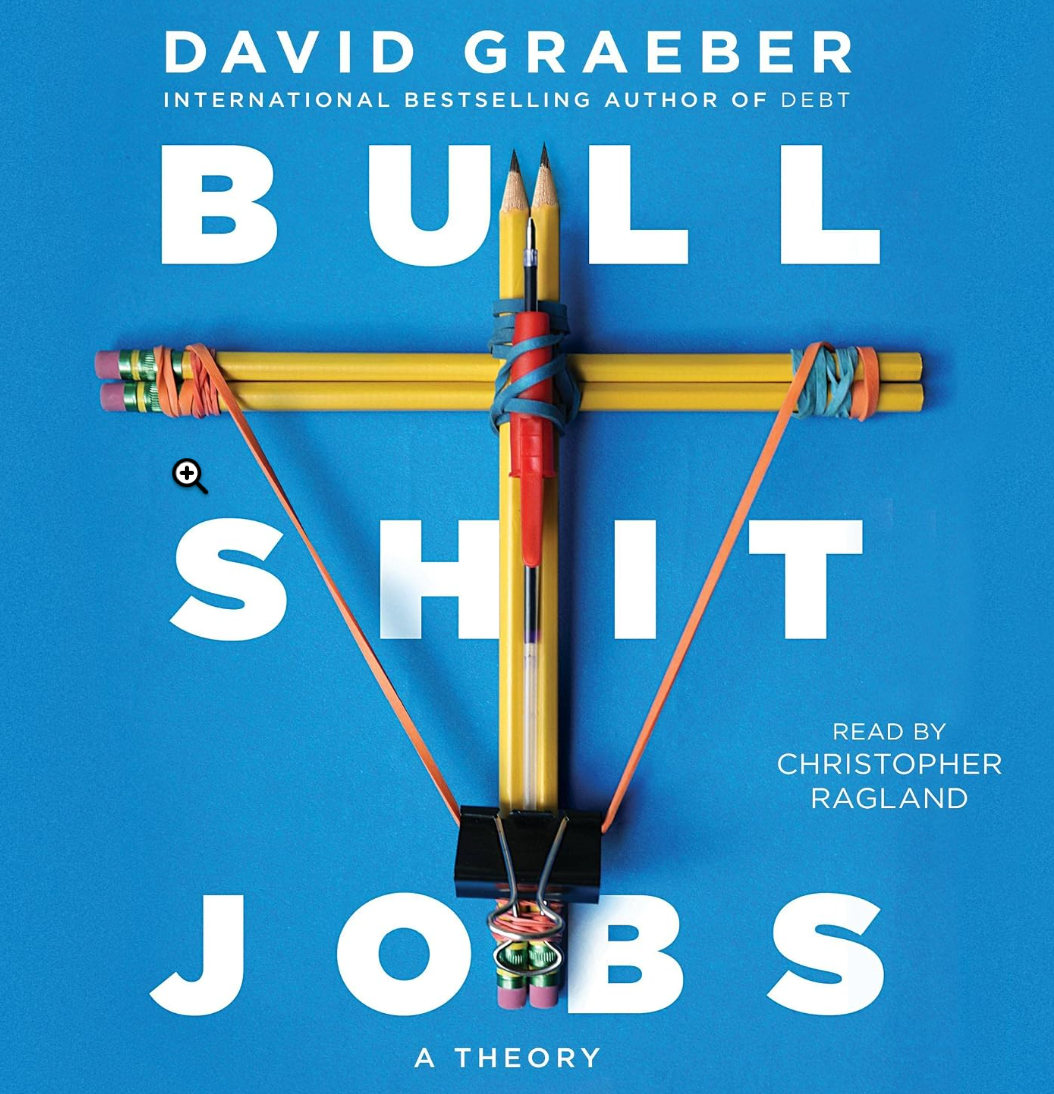
David Graeber's Bullshit Jobs: A Theory (2018) came out several years ago and I finally got around to picking it up.
It is hard to read because the shared personal stories sprinkled throughout are so depressing. It is a case study in dukkha, and sometimes, dukkha is hard to look at directly. Graeber's case studies are the banality of evil rendered as dukkha — and naked, outright evil is somehow easier to look at. A pile of rubble where people once lived, their bodies entombed in concrete, makes sense on some perverse level. For workers, the subject matter addresses things we see on a daily basis, and nothing is so disheartening as putting in a long day and then reading about the causes that make our jobs much worse than they need to be. Even if one has an okay job, there will usually be parts of it bearing shit stains that don't have to be there.
I was curious to see how Graeber would interpret the AI build-out and what it presaged for employment as AI continues to replace humans in the workplace. Would those few who managed to hang onto their positions suddenly find work easier, more satisfying, more meaningful? Bullshit Jobs was going to be a baseline of the pre-LLM era, with his more recent work re-evaluating his earlier conclusions. So I thought.
Unfortunately, he passed away in 2020 suddenly from non-Covid related medical issues. The book was an expanded treatment of an earlier 2013 essay, "On the Phenomenon of Bullshit Jobs: A Rant", which went viral. The essay struck a chord with readers that he admits surprised even him. Before long, he was receiving emails from people all over the world describing the mindlessness of their jobs, the spiritual violence committed against them in the name of capitalistic market efficiency.
Predictable pushback came from certain quarters (top-floor corner offices, to be exact), and, in truth, the subject matter deserved the much deeper treatment he gave it in the follow-up book. The essay was the equivalent of a rhetorical drive-by shooting in a tony urban district. It wasn't enough to sketch out the insanity of many modern jobs – ranging from toy warehouses to the top echelons of legal work – since the causes were not held up to a brighter light for deeper inspection in the original essay. As thinking social animals, we want to know why and how things got to be so fucked up.
A second desire was to see how he differed from my much shorter take on modern work in the blog post, "Why AI will not lead to a 'post labor' economy." Yet another blog post looks at a related theme: the possibility of an AI-backed leisure class for all of humanity, why it will remain out of reach given the direction of Western civilization and, more humbling, human nature.
Ossified layers in the Western psyche mean that most radical technological advancements don't necessarily translate into proportionally radical improvements in social life. We now have on-demand access to sensual and informational streams – confusing these for progress even as measurable declines in health, wealth and general happiness continue apace. The current social stratification looks pretty much the same, if not worse, than it did, say, one hundred years ago. Social mobility is much higher in countries like Sweden than in the imperial center known as America.
I'm living and writing after the dawn of AI in the workplace, but my assumptions are that the productivity increases brought about by computers even before AI's advent indicated that work – and human cognitive limitations – meant we were living in a stasis field. We still have the 40-hour work week, vacation days are still pretty limited, and the gains in output have only been redirected upstairs to the already wealthy.
The Catholic medieval lord gave his peasants a lot of days off to go party; the modern capitalist, not so much. Peter Thiel and others in his orbit have pointed to the absence of any real changes in technology for the last few decades despite the proliferation of data sets and computing power. Apart from the pretty color screens, though, not much has changed for the better. No flying cars, no (American) universal health care, no four-month vacations, no cures for cancer.
So I am sad that we will not have a Graeber follow-up that looks at the nature of work in the AI age. Then again, most of us know how this unfolds since the pink slips are increasing every month, but we do not know where all of this ultimately leads. Massive unemployment and labor dislocation in the next few years, then what? It's normal now to read about companies like Visa or Etsy slashing middle-class jobs over boasts of "efficiency" improvements. Unemployed people do not use credit cards much except to buy rice and beans at Costco, and they don't shop for crafted specialty items on Etsy.
The public sector went through its own downsizing in 2025, when Trump's DOGE – headed by (now) trillionaire Elon Musk – was used to make massive cuts to the public bureaucracy. America and the West more broadly were already on thin ice before the layoffs, with mounting public deficits whose ever-increasing interest payments mean a downsizing of public programs for healthcare, retirement, and infrastructure. Unemployed white-collar workers — paper pushers whose lives revolve around the pointless ticking of boxes – do not pay much in taxes. But then, neither do corporations. One ends up homeless, the other the beneficiary of bailouts and generous subsidies. If the plan is to send everyone home and mail them a nice check every month for no work to keep the consumer economy spinning, we haven't been made privy to it.
The West never really let go of its medieval roots, and modernity, from National Socialism to international capitalism, has been the story of trying to patch and fix this inheritance. While we think today of ancient Greece and Rome as the cradles of the West, in truth, what is Western really began in the medieval period, when social hierarchies based on the vassal/serf distinction took root. Despite the Enlightenment and the rise of liberal democracy, the basic vassal/serf structure still exists in attenuated form in the modern private corporate sector, with several sharpening filters (e.g., Puritanism, precise time measuring) applied in between.
In fact, it's actually worse since, as Graeber notes, lords in the old days were generally happy to let most of their peasants manage themselves. The farmer worked much less, had a bonanza of feast days to celebrate, and lacked any concept of middle management. To say, the hierarchy was a shallow one, and by the time of Shakespeare in England, there was a growing population of prosperous commoners and merchants with extra income. A productive province in France was probably much closer to the American ideal of faith, freedom, and family than his Iowa caucus voter descendant holding down three jobs is today.
Now, through the grace of technology and surveillance software, we have layers of middle managers and their entourages who use automation to make sure that workers are pecking on their keyboards and not using software or hardware hacks that simulate – and therefore, deceive – as to what they are really doing at their desks. Baron, viscount, and other titles have been replaced by vice president, senior, team leader, etc.
The burgeoning of bullshit jobs aimed at building a stable social system during the closing days of the medieval period created a cultural psychology which framed idleness as a social disease, one conducive only to riots and revolutions. While peasants had incredible amounts of free time to feast and celebrate, the Protestant revolution brought a massive increase in wealth inequality as lords began confiscating the vast holdings of monasteries. Large swaths of acreage in the U.K. are still held by private aristocrats, the lucky heirs of stolen goods who need never worry about being brought up on charges of theft or squatting. Those earlier aristocrats who pledged fealty to new Protestant kings were rewarded handsomely with lands once held nominally by the Catholic Church, but were in fact public commons.
Graeber doesn't dig into the work of William Cobbett and leaves a lot on the table in my opinion, but this is a minor quibble. While he talks at length about the concept of the commons, he omits to link this to the earlier religious revolutions, which are really the source of the malignant ruling-class attitudes still with us today. The monasteries fed, clothed, and educated abandoned children, cared for the elderly and sick, and functioned more or less as a capable social safety net for those who fell through the cracks. When this was all privatized, poverty and misery in England and Germany ballooned. Privatization of the public commons is a theme of the current and previous American presidencies, sold initially as "public-private partnerships," yet foreshadowing a full-on privatization of the social system in the name of "market efficiency."
This was Musk's DOGE in a nutshell: let us spend a weekend making up shit about your data problems with the help of AI at the Social Security Administration; we will cut all the waste and "streamline" the pension system with chatbots. But as Graeber recounts in story after story from private sector workers, the market is shockingly inefficient, wasteful, and dehumanizing in many respects.
As the medieval period went on, new positions emerged that became prototypes of the bullshit jobs we have now. Lords during this period figured out that it was good to keep your friends close, but your (potential) enemies closer, and so set about creating positions in their households, like the livery boy. This was a young male given the task of running alongside carriages, checking the road for bumps and holes which might upset the occupants. Other positions included wearing a uniform and holding the door for important personages. Still another job was to walk ahead of a lord into rooms, lending an air of importance. A lone man walking into a stately room is one thing, but an entourage of attendants signals power and status – in a word, presence. The human ego wants to be known, seen, and appreciated.
Lords were willing to extend their household staff since it let them keep an eye and ear on their subjects while inflating their own sense of self-importance. These men extracted considerable wealth from the peasants and, to offset any ill feeling that might spring up as a result, they kept their sons busy with pointless jobs. Many of these look like vanity projects aimed at demonstrating wealth and control on the part of aristocrats because they were. Members of the lower classes could end up as status ornaments, their meaning reduced to carrying out silly tasks on behalf of a nobleman who wanted others to know his wealth and importance.
Medieval Catholicism had a certain laissez-faire attitude to work. While the Benedictines had their ora et labora motto, work for a peasant farmer was not nearly as onerous as that of a 19th-century factory worker, with frenetic activity confined to a few periods each year. Supporting trades like blacksmithing were also tethered to seasonal cycles. Work then was task-based, not time-based; task completion mattered, not filling a sizable block of the day on a corporate timesheet for its own sake. This distinction appears in E.P. Thompson's 1967 essay, "Work, Time-Discipline and Industrial Capitalism," which Graeber likely drew on in his work.
This simple model of rest, rest, rest – GO! – is closer to the work life of our ancient hunter-gatherer ancestors. Graeber, a doctoral student of Marshall Sahlins who worked on time-sensing among so-called primitive societies, notes that the concept of "selling one's time" in exchange for payment would've been bizarre not only to medievals, but to human societies generally in the pre-modern age. People simply didn't sell "their time" for money because the idea was incoherent. Today, we don't think at all about our ability to sell an unaswerable, invisible force to another in exchange for money. It's not ours, it's not anyone's; we belong to it. Human labor accounts for most of the cost of any good, so it's this we pay for mostly when we buy something – not a period of time which may or may not have included steady continuous activity. This labor-value theory lasted until the end of the 19th century, when economists argued that consumption, rather than production, was the engine of prosperity and progress.
One of the quirks of modern market efficiency is that it doesn't reduce labor, just increases the workload needed to fill the 8-hour day with busyness, captured pithily in the 1950s by a priest of Saturn and formulated as Parkinson's Law: "Work expands so as to fill the time available for its completion."
The industrious Puritan could point to a theological basis for his slavish dedication and work ethic, as an investment in the promise of a better future afterlife. The modern has nothing so ambitious, just the need to "kill time," maybe get so lost in work that she forgets herself, becoming a member of the elite club of "workaholics" celebrated by the media. This counterfeit anatta – a near enemy of the not-self doctrine taught by the Buddha – will be discussed later as it relates to Graeber's take on "meaning."
In the wrong hands, the venerable Benedictine work ethic is used as a sacred injunction to work long hours even when the work itself is pointless, pitiless, harmful or just plain wasteful. God is not impressed that you stood 7.5 hours today slaving over a hot photocopier when the same task could have been automated with a far more accurate, time-saving digital document system. This is one of the many dismal actual cases the author reports. From the Puritan's point of view however, any work – not prostitution and the like of course – was cause for sanctification since it meant the doer was active in a shared effort.
This psychology is a badly devised therapeutic for the problem of dukkha, the heedless mind swimming in a stream of inconstancy and anxiety. The Protestants never developed a lay meditation practice, so they found the only way to slow the agitated monkey mind was to keep it busy in production. Good, bad, pointless – it doesn't matter so long as the mind is not left to fidget over the inevitabilities of old age, sickness and death. Despondent thoughts on these themes can inflame the passions and lead to a disorderly society, or press the heart so far down it loses all vitality and any inclination to work. It's not hard to see how this contributes to the creation of bullshit work carried out atop the rubble of medieval civilization. If work is sanctifying, then who will be the first to step off its train and into the mouth of hell?
Some moderns like to see in the Benedictine model a rudimentary proto-capitalist laboratory in which unwashed pagans were taught the value of time management (praying the hours) while learning the value of honest labor, rather than petty thievery and cattle rustling. The Viking raiders who harried northern Europe intermittently for three centuries were eventually Christianized, and their descendants adopted new notions of time management, planning, and personal conduct.
Saturn, the demiurge/overlord of time who divides and apportions human life according to schedules, appointments, meetings and so on, was subsumed into the Western notion of god with the arrival of the clock. The issue with monotheism is that, while the word "god" seems familiar and constant across time, the concept is a rather large trunk whose contents are always changing. We ended up with a Saturn when we were promised a Yahweh, the very same god who commanded his followers to take a day off every week and do nothing. (And who, by the way, also commanded the celebration of festivals and debt jubilees.) Both wear the name "God." The sleight-of-hand goes undetected. Even the poor old Saturn of our times is a switcheroo, swapped in with an earlier form (Kronos) who had nothing to do with TPS reports. Fraud upon fraud.
Having spent decades filling out pointless timesheets, I decided to accept that Saturn is pretty real and yes, I have a personal relationship with him now. Not a good one, but a personal one. Someday he may go back to carrying a sickle instead of a punch clock.
Europe, as Graeber notes, adopted church and tower clocks to remind people to pray, but these mechanical contraptions also shaped consciousness to see time as finite and precious (especially during plagues). By the theology of the period, earthly activity must be ordered to the Four Last Things – death, judgment, heaven, hell. Pre-clock medieval communities spent years building the great cathedrals of Europe, and it seems their more relaxed sense of time made the effort communal, needing neither middle managers nor Excel spreadsheets.
Chartres will be finished when it's finished (it took around a quarter of a century). This is perhaps the highest output of the Western task-based model, one which tourists still flock to see every spring. The quality of the cathedral's design and construction was a product of skill and devotion, supported in part – at least according to pious legends – by people who volunteered their labor out of an abundance of free time. The Trump administration's recent installation project for a protective liner at the Washington Monument reflecting pool to prevent algae blooms was ten times over budget, improperly installed, and failed immediately. I bring it up because this was a highly visible, state-backed project in preparation for the country's 250th birthday, which is arguably the most powerful nation to have ever existed.
Missing from the proto-capitalist reading, though, is that the Benedictine concept of work does not translate directly to a secular capitalist context without losing a lot. There is work, and then there is the abject kind which begins to look like indentured servitude, whether to a princeling or a corporation. The theological cloak worn by work was eventually dropped, exposing an all-too-human drive for mastery over material reality, including other people.
I will discuss later how Buddhist mindfulness underwent its own special kind of mangling as capitalism introduced a distorted variant via professional development workshops. This is a subtle theme in the book: how religious practices get co-opted to carry water for inhumane economic systems—the medieval psychology surviving, desacralized, well after the theology has faded.
Chapter 7 begins with a quote from George Orwell, one I wished was before me when discussing Yuval Noah Harari's comments on the dangers of AI, including the likelihood of people sitting around on the UBI dole, smoking pot and playing Call of Duty all day, when they could be feeding medical record documents into a photocopier, or shaking down homeless people for three forms of ID to get their state assistance going.
I believe that this instinct to perpetuate useless work is, at bottom, simply fear of the mob. The mob (the thought runs) are such low animals that they would be dangerous if they had leisure; it is safer to keep them too busy to think. — George Orwell, Down and Out in Paris and London
Orwell identified Harari's fear of the universal leisure society decades before the latter became the court intellectual of the WEF cathedral and began giving hysterical talks on the perils of a machine-run future.
Harari credits long sits at Goenka meditation retreats with his ability to produce depressing books – ones that sit on bedside tables of oligarchs throughout the world. He writes about homo deus, imagining a future world where humans have become Titans, wholly other, yet lacks the imagination to see Graeber's UBI world where homo ludens spends ample free time playing kickball, restoring classic cars, growing vegetables and creating cleverly laid-out parks.
Goenka is a stripped-down, Diet Coke version of Buddhism which hangs onto the bits and pieces considered therapeutic while enervating the soteriological purpose of the buddhadhamma – the cessation (nirodha) of craving, the end of the defilements and the completion of the holy life. "What was to be done has been done," as the Pali texts say so frequently.
A 20th-century meditation school cobbled together from overexposure to the commentarial tradition and Burmese practices, Goenka's method purports to be scientific, non-sectarian, and therefore, suitable to anyone with the patience to scan her own body mentally, follicle by follicle, pore by pore, for ten days straight in hopes of experiencing weird vibrations. If this sounds like a practice that can lead to hallucinatory dissociation presenting as meditative calm, you're right. It's also the kind of mental state that can fortify one to play courtly sycophant to oligarchs or endure a bullshit, soul-sucking job. It's certainly not anything like what the Buddha laid out as "good in the beginning, good in the middle, good at the end."
Look behind founder S.N. Goenka, an industrialist whom Harari calls "his teacher," and you find a Burmese lay accountant general – Sayagyi U Ba Khin – who pushed his version of meditation in a government office to combat corruption and improve efficiency. Lest anyone think the oligarchs aren't drinking the mindfulness Kool-Aid as well, there is Jack Dorsey, founder of Twitter and billionaire, who tweeted wellness metrics while on a ten-day Goenka retreat in Burma during a brutal government crackdown on Muslims.
In the Deep South, the Bible Belt of the United States, at least one Goenka retreat center exists in Jesup, Georgia, called Dhamma Patapa. Go figure.
The Eastern meditation technology promoted throughout the West to help people with the pointlessness, the sadness, the spiritual violence of modern work that Graeber humanely writes about leads to torpor, makes one a passive, calmer worker who uses "mindfulness" to dissociate from the immediate pain of feeling useless to others. It doesn't lead Harari to question whether the bullshit jobs which cause depression for many millions are the real problem. He doesn't consider that his own privilege affords him the time to devote a chunk of his year to pointless Goenka body-scanning retreats, and that perhaps others would find their own worthwhile spiritual pursuits if freed from compulsory work. Harari enjoys what others would also like: free time, a social benefits system, and universal healthcare.
That some people will smoke pot all day and play video games is a given, but Harari's model completely overlooks that no human society has been in a position to implement UBI, to do something truly novel in the history of the species. As Graeber notes, the deadbeats will still have workaholic counterparts in a UBI world to offset their inertia because private employment will still be an option for people who want to boost their income over and above UBI. Harari's dim view of human nature means he doesn't want to attempt such a project even as two large wealthy nations (the US, Russia) fight against smaller, economically weaker opponents (Iran, Ukraine). If artificial scarcity, inequality and grinding poverty – the kind at the root of most violence – could be halted, does he think the human race would be worse for the attempt? The man who writes books about possible futures is not interested.
Against Harari's grim assessment of humanity, Graeber points to a profound theme in the worker testimonies he shares: the meaninglessness of the bullshit job stems from a sense of worthlessness when measured against genuine humanitarian contact with others. Caring professions like teaching provide widespread social benefits to many, and their practitioners are remunerated with lower wages and vilification by right-wing populists. It's a paradox: Those who provide the greatest social benefit are paid the least.
In my short stint as a nurse's aide, the job paid extremely low wages, had zero social respect, and involved tending to the most vulnerable in the closing days of life. Many people die in care homes with the last person they see being an aide who makes slightly better than minimum wage.
Frequently, a nurse's aide spends much more time with a dying parent than the parent's own children, who are adults with their own all-consuming careers and family to look after. Corporate lawyers, by comparison, are well paid, have social standing, and shuffle the same boring paperwork daily while providing questionable social value outside of a very small circle of the well-to-do. Here, the lawyers who've shared their stories admit to depression over having so much and doing so little in return for the greater good. They carry a guilt that dampens the pleasure of success and prosperity.
Some cases in the book involve people taking significant pay cuts just to have a job that gives them the sense of self-worth that comes with serving others. Service does not mean "no pay." The clergy is still paid a living wage per the New Testament: "the laborer deserves his wages" (1 Tim 5:17-18). This topic of widespread altruism is conspicuously absent in Harari's writing, signaling that he's quite isolated from what most ordinary people are like and what they face.
Drawing from Groos's "the pleasure at being the cause," Graeber describes the joy infants experience as they discover their power to act as agents in the world. This is so foundational to our expectation of life that by adulthood, when a person enters her first bullshit job, the abrupt withdrawal of her creative power – and here I point to Graeber's reflection on Yahweh as creator in the Western religions – leads to a collapse in self-worth. The imago Dei is hidden underneath a stack of TPS reports.
From a Buddhist perspective, the question of meaning, sense of self, and social worth emerged in the stories Graeber shared with total strangers about their work lives, which touch profoundly on how we define ourselves.
In the wrong hands, the doctrine of anatta can be used to oppress workers by altering it to say something like, "There is no real you anyway; your pain and disappointment are caused by an ego that hallucinates itself, and only by calming the fictional mind can you have anything like enjoyment on the job."
No corporate wellness consultant ever says or thinks this, but the path of meditation and cherry-picked "Eastern" concepts can be subconsciously adopted as a remedy for the discontent people feel in shitty workplaces. This is already seen with the Puritans, who began peeling back the theological cover for greed as divided Western Christianity moved deeper into the desacralization of public space. The Reformation and the subsequent Enlightenment eras can be characterized as the eradication of religion as a co-equal parent in cultural nurturing.
More recently, the post-Conciliar Church's rescinding of the days of obligation was an internal concession: in today's busy, market-based society, it was too hard for people to make it to Mass before or after work to honor Jesus, his mother, and the saints.
A generic view is that religion answers the problem of pain, but our societies are secular, so we should find some kind of happy compromise, one that jettisons the woo-woo, problematic stuff that sets off the legal department and focuses instead on practical tips for better living. Or psychic pain management, take your pick. Managers inviting employees to morning prayer before work starts is bait for a labor lawyer, but mandatory "mindfulness" workshops get around this. Drop rebirth, Right Livelihood, devas, and the potential omniscience of the Buddha; keep the bits about "mindfulness" – in other words, pay attention to what you are doing and, in that, find contentment with your stupid job. It makes you a better, more docile worker who contributes to the bottom line. Mindful workers make fewer mistakes, but if they make fewer mistakes and become more efficient, they still have to put in a full 8 hours.
Who is mindfulness really for? The worker, her boss, the system?
Graeber's informant Irene provides some feedback on her mindfulness training in chapter 5:
On top of the metrics, there were the cruel, patronizing “flexibility” and “mindfulness” seminars. No, you can’t work fewer hours. No you can’t get paid more. No, you can’t choose which bullshit projects to decline. But you can sit through this seminar, where the bank tells you how much it values flexibility.
The mindfulness seminars were even worse. They attempted to reduce the unfathomable beauty and stupefying sadness of the human experience into the raw physicality of breathing, eating, and shitting. Breathe mindfully. Eat mindfully. Shit mindfully, and you can be successful in business.
No matter how "mindfully" an employee places an ass gasket on a toilet seat and then does her business in the office toilet, if she's working in a plant that manufactures Tomahawk cruise missiles, or tending the counter in a liquor store, her desired object will not be found since both of these examples contravene the Fourth Noble Truth's commitment to Right Livelihood. This may seem a bit pedantic to non-Buddhists, but the path of Right Mindfulness (samma-sati) is but one of eight practices that the practitioner follows in order to obtain nirodha, and in the canon, the catalog of these is presented after the Third Noble Truth. "And this, monks, is the noble truth of the cessation of suffering: the remainderless fading and cessation, renunciation, relinquishment, release, and letting go of that very craving."
The mindfulness training Irene received is explicitly identified as micchā-sati in the commentaries: the near enemy, the counterfeit as it were, of what the Buddha taught as one of eight pre-conditions – actively developed factors – for liberation. The path factors are interdependent, and none of them can be ignored or treated as less important. To set up mindfulness in isolation, without reference to Right Livelihood (for example), is to hold up a defective mindfulness as a model for how to behave. Right Speech must also be cultivated, so if your job is calling people unsolicited to sell them junk they don't need, then mindfulness will remain stunted at best.
Irene may sadly never know this in her current life. She will twitch if she hears the word even from a knowledgeable practitioner because it will be associated with the HR department requirement she had at an old bullshit job. Buddhist mindfulness and other practices have to be sought in the West by those in pain, who have asked themselves whether death would be better, decided very wisely against it, and then gone looking for remedies outside of traditional Christian religion. Corporations and their retinue of consultants cannot push it in whatever miserable way.
I focus on Right Livelihood here because, in any discussion of modern work, many available jobs involve acting in a very unethical capacity that harms others. The "uncaring" jobs, if you will, are only briefly mentioned by Graeber (hitman), but they are out there and frequently not even recognized for what they do to people because they are legal and therefore socially accepted. A pest exterminator as a day job will never balance with the pursuit of authentic mindfulness. Snipers have excellent concentration and their own kind of mindfulness, but this doesn't make them worthy models for how to live.
Graeber focuses on the pointlessness of what passes for work today, and this sidebar in no way seeks to diminish an ethically informed view of the causes of human suffering. It stands on its own strength, as something that needs to be said to a broad population made up of believers, atheists, and non-conformists living together.
There is an apparent tension for a Buddhist in the discussion of meaning, self-worth, and value in work life, and the underlying teaching of anatta: this is not mine, this I am not, this is not my self. The lineages have adopted the theory of a conventional self with unique characteristics: I am French, these are my parents Henri and Ann, I work at a tea factory, my hobbies are soccer and camping...
But these are plastic emblems that melt and reform from lifetime to lifetime. The true disciple of the Buddha puts no stock in them, wears them with no strong attachment or excessive enthusiasm.
The full-out objection on stereo blast sounds like this:
If there is no real underlying thing worthy of being called a Self, no permanent substratum to the human person, then it shouldn't matter whether one spends 2,000 hours every year ticking pointless checkboxes on private insurance forms so long as the activity is done ethically. Pointlessness is a neutral field for the cultivation of enlightenment, and our attitude towards it determines whether we experience pain and suffering on the job, or whether we use it as an opportunity to witness the impermanence and unsatisfactoriness of all things. Graeber shares testimonies of people who are not doing anything harmful for the most part, so what's the problem?
Early in his book, Graeber shares Dostoevsky's thought experiment of a man forced to pour water back and forth between different pitchers all day. This is his job. The process, however, is torture, and any system that justifies pointlessness in the carrying out of senseless tasks as "work" has become inhuman. Mindfulness doesn't make torture stop being torture. The House of the Dead shows convicts living in Siberia who made bricks under compulsion, but their activity had a real purpose, and there was the possibility for human excellence. Pouring water, however, is designed explicitly to annihilate a man's sense of having any value to others. It brutally denies him the chance to live out as Groos's creator, a participant in making the world a better place.
Zen and Theravada monks both relate that their daily activities of cleaning and tending their monasteries are pursued with the goal of excellence. Sweeping the floor is for others, but it is also meritorious because the bhikkhu can do something for his brothers and the laity that produces a clean tidiness conducive to the well-lived life.

An arahant could, in theory, spend all day sorting thousands of paper clips by size and color for no obvious reason other than his boss told him to, and still never lose his attainment. This is an admittedly strained example because it is impossible, but a good mental exercise nonetheless since it highlights that there is one who already knows everything is ultimately pointless (except liberation) and touched by dukkha; and that there is a possibility of a completed state in which any stupid task can be done with serenity, detachment and joy.
The arahant is not the despondent nihilist of a 20th-century novel after all, but one who was seen, despite her corporality, the deathless face to face. Therefore, if your job is blunting your enthusiasm for life, draining the vitality right out of you, then the problem lies with you and the paperclip arahant convicts on this charge. If you focused more on moving toward arahantship in all things great and small, and spent less time complaining about the paperclip sorting, you will save yourself much grief. Or to put it more colloquially, your attitude shapes your reality. Think happy thoughts, or do as the "Buddhists" do and just blank out completely.
However, what a paperclip arahant can survive without loss tells you nothing about what an aspirant should choose to do when confronted with a job that leaves her deflated, disassociated, and despondent. The arahant has completed the work while those behind her struggle with the basics. It's not okay to load these people up with ridiculous expectations.
I add that what energizes people is being of use to others, according to Graeber's theory of caring. Therefore, the quality of all human life is judged by the cultivation of metta that translates into daily acts of kindness along with sympathetic joy (muditā) at the success of others, and an openness to share in the disappointment of another's setbacks (karuṇā).
Again, the HR department, corporate wellness coaches, and the like are not out to subvert Buddhist doctrine. Westerners went abroad, found a religion that had practical therapeutic uses, and then de-contextualized it to make money from consulting fees, books, and seminars. In the process, they unleashed an arguably harmful practice on workers. People like Irene know bullshit when they see it. The mindfulness workshops don't fool anyone.
The people of the Buddha's time were mostly farmers, tradesmen, scholars, priests, warriors, and rulers: in this world, the luxury of supporting a large population with fiat money for bullshit jobs wasn't an option. The notable exception of people who did not work in the usual sense were those gone forth into homelessness, owning almost nothing and living on the kindness of others. Classical Indian society, like medieval Christendom, placed great emphasis on cultivating contemplative orders because they redounded to everyone's benefit.
Every bhikkhu in Thailand or Burma is a field of merit for the layman (prisoner to king), a living emblem of the dhamma which binds the wounded heart. Ancient complex societies only made allowances for a single class of non-income earners, proto-UBI recipients, if you will, because that was all they could afford. Where they chose to spend their limited resources says much about social priorities. They did not create bullshit jobs, however.
Graeber gives his own reasons for the why of bullshit jobs, and the later chapters explore these in depth. I will add that these have a much more mundane material reason for existing, which he doesn't address directly: Empire.
The U.S. has held world hegemon status since the end of World War II and has used the imperial wealth pump effect (John Michael Greer, Decline and Fall: The End of Empire and the Future of Democracy in 21st Century America) to extract considerable resources from the rest of the globe, to give out as gifts to its allies in Europe and elsewhere. For Greer, collapse is catabolic, a tier-to-tier gradual contraction accompanied by growing material scarcity and, more importantly, a weakening of the social network.
Greer is a Western occultist, and he gives the personal example of the Odd Fellows, who once ran a successful insurance program. When one of his forefathers, a member, died in the line of duty, the group stepped in and paid an indemnity to the widow for the rest of her days. Today, the Odd Fellows lodge in his town is boarded up. The state, via its sprawling bureaucracy, extracts and centralizes the wealth of the entire nation, and the tangible social spaces are abandoned as people withdraw into their private worlds.
The wealth extraction is pretty clear to see. The U.S. population makes up 4% of the world population yet consumes something like 16% of the world's energy supply. It uses up resources far beyond what it gives back, unless highly inflated asset classes are counted.
Imagine for a moment what a single barrel of oil produces; how it would've taken dozens, if not more, in manpower in the medieval period to do similar work. In fact, it's much starker: A barrel, in fact, is the equivalent to what one man expends in seven to ten years of labor. So-called cheap energy has enabled the U.S. and its vassals to afford the luxury of having overstaffed public and private bureaucracies completely disconnected from the kind of materially constrained reality that the rest of the planet negotiates daily. The dollar-based trade system lets unnatural processes – like shipping frozen fish to China from North America for processing and then back in an 8,000-mile circuit – abound along with the creation of bullshit jobs which are all directed at sustaining the growth of the managerial and specialist classes. Covid showed how fragile our worldwide logistics systems are, how heavily dependent the nation is on China and other countries for the production of essential goods like medicine.
All late-stage empires undergo system shocks and failures as their complexity and resource needs outpace what they can produce domestically, secure by military force, or obtain by favorable trade agreements. Tainter's The Collapse of Complex Societies examines, among other examples, the stair-stepping down that happens as overloaded leadership hierarchies wobble against internal and external pressures; perpetual wealth extraction becomes no longer possible owing to environmental or other factors. More often, Tainter argues, declines are rapid, happening in a few decades.
Specialization, what Nietzsche mocked in the academic who obsessively studies the brain of leeches his entire life, lowers system resilience by diverting generalist survival skills into narrow, time-consuming, pointless tracks. People who spend a huge chunk of early adulthood in training and education, another luxury of technology, cheap energy, and reserve currency status, will wake up one day to a world where occupations like museum curator and technical evangelist are nice-to-haves only. Caring professions will become even more essential for stabilization and recovery and will probably still be paid next to nothing.
Graeber mentions that as much as 50-60% of jobs in the post-industrial West are bullshit jobs; or involve a high degree of bullshit that, if trimmed, could easily give us Keynes' 15-hour work week; or even send people home altogether, to collect UBI and pursue their real interests, no matter how unconventional.
I mentioned that Graeber didn't live long enough to write specifically about our AI age, but he did address work automation towards the end. He doesn't use the words "AI" or "Artificial Intelligence" at all, and he gives a funny example of "complicated" history course planning diagrams requiring human cognition to understand and implement; to say that his conception of "robotics" is limited to manual labor and repetitive manufacturing tasks. Humans have a worth that no machine can replicate for higher concepts like value. His history course diagram example represents a set of complicated variables which, when weighed, lead to a good decision as to the best course to take for an individual with her own tastes and goals.
A machine in 2018 could not have aided this analysis readily for a youngster living in the suburbs, but 2026 software developers in fact use AI agents to do even more complicated work, beyond just sorting syllabi, course descriptions, and professors based on some complexity. He is crucially right, however, that a human is needed to stitch together interests, personal goals, and talents, ordering them to a telos. This is something AI can help with greatly by pointing to options, but they lack volition, the power to choose one good over another. It seems especially cruel to build AI systems and data centers that can greatly assist people in personal development while, per Parkinson's Law, filling up the possible extra free time with purposeless tasks.
In 2026, these very same course diagrams can be read by an AI agent, assessed, criticized for strengths and weaknesses, and improved with the combined knowledge from all fields of endeavor – and then improved again, made humanly meaningful, by a particular person's input. Think Microsoft's slogan from the mid-90s: "Where do you want to go today?"
Mathematical problems once thought intractable have been solved in recent months by LLMs, causing a crisis of meaning (that word again!) among professional mathematicians. At the point where AI – mere LLMs – are solving our most complex class of abstract problems, it sounds extremely tinny to assert that anything like full employment is attainable or even desirable. It is in fact perverse to entertain for a moment the prospect of cities overflowing with unemployed scientists, mathematicians, nurses aides, tool and die makers, and pre-school teachers, all living in tents because of AI. As he says at the close:
It’s hard to imagine a surer sign that one is dealing with an irrational economic system than the fact that the prospect of eliminating drudgery is considered to be a problem.
This isn't to say that, post AGI, humans are unneeded or unwanted in all the various fields – they will be at least for the foreseeable future – only that the case for stupid entourages and ego-stroking of the rich will no longer hold water. The incredibly expensive and wasteful private medical industrial complex in America will no longer have an excuse for its shittiness, bad outcomes, grasping biotech scams, and coercive tactics (e.g., Biden's September 1, 2021 decree forcing workers to take the Covid jab or face job loss).
Graeber goes even further: We actually already crossed the threshold to automation, and the bullshit jobs are just there to hide this fact. As he says in speaking of leisure prophets like Keynes:
They were entirely accurate. Automation did, in fact, lead to mass unemployment. We have simply stopped the gap by adding dummy jobs that are effectively made up.
Given Tainter and Greer's differing though complementary models of collapse, we have been handed a boon with AI because no previous civilization in decline had such a powerful resource for lowering costs, eliminating waste, and redirecting human energy towards more productive, uncompelled activities. Tainter might see AI as just another case of unsustainable complexity, but many of us see it as sui generis, the opening of a new epoch for the species since it doesn't require the maintenance of intricate, purely human organizations. We can scale because the weak link – human inconstancy on the collective level – can be nerfed to some extent. We do not know if Tainter is right until we try. He's owed the same response given to Harari: We have to at least try this new wonder for some other end besides perpetuating medievalism and perverse wealth inequality.
Humans can excel when they are given the tools at the micro level to become, to use Jensen Huang's phrase, "force multipliers," in the pursuit of great ends. "Great ends" can include taking care of aging parents, being a full-time mom, getting people outdoors into the sunshine to undertake community improvement projects, etc.
Large creaky social hierarchies of the kind Tainter discusses are a different kind of abstraction altogether. Their complexity and brittleness are directly tied to individuals' cognitive limits. AI loosens these limits, and the routine, complex forecasting and planning that are error-prone in humans become much more stable with AI augmentation. AI in the hands of individuals becomes the broom the bhikkhu uses to sweep the monastery grounds. It becomes another occasion for merit-making, or, to use the Christian phrasing, "an occasion for grace."
I asked an AI one evening whether there were any historical examples of a society in a steep nose-dive, with the ground rushing towards it, where it pulled up, straightened out and started climbing again. Tainter provides one: the Byzantine Empire of the 7th century, which undertook significant reforms that kept it going for hundreds more years. Among these reforms was reducing the bureaucracy.
If Byzantium's rulers could breathe new life into their society by getting rid of bullshit jobs, imagine what we can do with AI.
Talking Heads, "(Nothing But) Flowers" Official Music Video