Uncle Ted, pt. 3


Bronze Age Collapse: Organization-Dependent Technology Failure in the Distant Past
We distinguish between two kinds of technology, which we will call small-scale technology and organization-dependent technology. Small-scale technology is technology that can be used by small-scale communities without outside assistance. Organization-dependent technology is technology that depends on large-scale social organization. We are aware of no significant cases of regression in small-scale technology. But organization-dependent technology DOES regress when the social organization on which it depends breaks down. Example: When the Roman Empire fell apart the Romans’ small-scale technology survived because any clever village craftsman could build, for instance, a water wheel, any skilled smith could make steel by Roman methods, and so forth. But the Romans’ organization-dependent technology DID regress.
—§208
(This continues my Uncle Ted series. Part 1, Part 2)
For a consumer to own and operate a modern refrigerator, a networked system of specialized industrial factories must first exist to fabricate the widgets that go into the final product he orders from Best Buy (cf. §208).
Manufacturing a refrigerator that preserves food is a serious undertaking; we think nothing of it now unless the one in our kitchen dies or the power goes out for a few days because of a natural disaster that takes down the electrical grid. Beyond the subcontractors that produce individual components, other parts of the logistics chain handle raw materials like copper and aluminum that end up in the unit. In the last ten years, I've probably lost over a thousand dollars to spoilage because multi-day outages and natural disasters took freezers and refrigerators offline.
Small-scale technology, in contrast, has a local supply chain, however you define local, since the Unabomber provides no measure. Is local 500, 50, or ten miles? "Without outside assistance" (§208) is the rule for self-sufficiency, but lacks any metric for applying it. Are New Yorkers "outsiders" to South Carolinians?
With human wants infinite, your rugged community may start with a rule of thumb: the distance a man can walk in three days to acquire materials, then later push it to the distance the same man on a horse can travel, as prosperity takes hold and human desires expand. Your small community grows, and soon merchants travel 500 miles one way to get the materials needed to support the current population. If you played any of Sid Meier's Civilization sims, you will know where I'm coming from.
If your plan is to limit population growth to keep things "local," then birth control, abortion, and infanticide will be on the table. But reliable birth control requires an industrial system, so the choices narrow down to unreliable birth control methods, abortion, and infanticide. Once these come into play, it's not clear how Kaczynski's (aka FC, "Freedom Club") self-sufficient, small communities avoid becoming mini-models of the eugenics programs he condemns as the inevitable by-product of advancements in medicine (§122). Whether nature is allowed to work her magic or self-directed genetic engineering takes root, the result is the same. Both the techno-state and older pre-industrial civilizations must remove excess human population.
In his view, the techno-state will eventually resort to forced genetic modification and human culling because these offer a solution to the disappearance of selective pressures, which in the past would have handled the problem of congenital disease naturally. Mandatory gene therapies remove bad genetic traits, and as artificial changes accumulate and spread through the population, humans will stop being human and become a self-engineered species instead.
This may seem like nitpicking, but it matters because, long before human societies industrialized, they relied on extensive, far-ranging supply chains for critical goods. They did not depend on electric refrigerators and refrigerator parts like coolant, motors, and thermostats, but they did lean heavily on imported food (e.g., grain shipped from Egypt, as the Romans' case he cites) and, in the Bronze Age, on the distribution of copper and tin.
Suppose a neighboring country ruled by an autocrat suddenly begins using bronze to strengthen its army and improve the quality of tooling used to build its fortresses. The despot gladly sends his merchants as far as needed to obtain the materials to create the alloy because it is so indispensable. In the long term, bronze tools and weapons are cheaper to make, last longer, and perform better. In this situation, does your community rely on the neighboring despot's good disposition, trusting he will leave you alone, or do you send your own caravans to secure the same alloy ingredients for your people?
Early bronze alloys used copper and arsenic rather than copper and tin, probably because arsenic was easy to source locally. But it was also less reliable than a tin alloy. Unlike arsenic, tin was non-poisonous, so communities that wanted to keep their smiths alive and healthy were willing to send donkeys and ships to secure it. (Ötzi the Iceman's (d. circa 3300 BCE) remains were recovered from a melting glacier in 1991 in the Italian Alps; his hair showed high levels of arsenic, suggesting that he was exposed to copper smelting.) Multi-faceted human needs made organizational dependency on copper, tin, and their trade networks inevitable during the Bronze Age. No global corporation controlled bronze production.
While the Unabomber anticipates a despot state gaining a technological edge over its neighbors, he doesn't fully realize that materials and trade systems are as old as civilization itself. Even without large-scale organizational technology, international trade still carries systemic risks, as the Bronze Age Collapse demonstrates. Thus, he cannot appeal to the state of nations 500 years ago (§211), since they were already enmeshed in critical trade systems. Modern technology adds technique and method to a material foundation.
Forget refrigerators, cars, and computers for a moment, and recall that during the Bronze Age Collapse, when bronze and established trade routes disappeared from the eastern Mediterranean region (for varied reasons), entire civilizations vanished with them. It happened suddenly, leaving a gap in our historical knowledge of the consequences, since very little survived the resulting tumult.
The Bronze Age Collapse had very little to do with vulnerability in large organizations. There was no direct equivalent to Apple, Ford, or Tesla then, but the same negative outcome occurred, even though bureaucracies oversaw trade. None of these, however, gutted themselves and their societies for a quick profit.
Humans crave goods that make life bearable, whether spices, medicines, alloys, or books. When they become unobtainium, humans go back to the drawing board. FC's manifesto fights against a 10,000+-year-old compulsion to find comfort and ease.
Before technoindustrialism, trade collapses erased civilizations, so technology alone isn't the only existential threat a society faces. Rebuilding resumed after the Bronze Age Collapse, and the cycle of technological advancement continued. The difference between that example and any potential collapse in the near future is that workers then at least had skills to fall back on. The fall, so to speak, was not from a great height. A smith was still a smith and could switch to secondary local materials, like iron, instead of tin and copper. Today's complex systems mean a highly skilled worker, reliant on machines and the techniques they assume, can become completely useless if entire sectors disappear.
Big Organization Technology Self-Sabotage
More reasonably, it is argued that if the relatively democratic nations of the world fall behind in technology while nasty, dictatorial nations like China, Vietnam and North Korea continue to progress, eventually the dictators may come to dominate the world. That is why the industrial system should be attacked in all nations simultaneously, to the extent that this may be possible. True, there is no assurance that the industrial system can be destroyed at approximately the same time all over the world, and it is even conceivable that the attempt to overthrow the system could lead instead to the domination of the system by dictators. That is a risk that has to be taken.
—§195
In the West, some semblance of technological overthrow did happen without a revolution. Between the manifesto's publication in 1995 and today, the U.S. and Europe have de-industrialized, sending factories and technical knowledge to cheaper locations in the Global South.
China especially has been the beneficiary of American capitalist largesse, whose controllers eagerly placed all of their eggs in a basket held by the Chinese Communist Party (CCP). American capital and know-how flowed into Chinese businesses (often state-subsidized and tariff-protected) to reduce labor costs while bypassing the environmental hazards of industrial production. American capitalists made the Chinese manufacturing build-out possible, and countries like Germany and the United Kingdom followed suit to preserve their own comparative advantage. Private companies like Apple Inc. benefited from outsourcing in the short term, producing expensive consumer gadgets at high profit margins.
The CCP is authoritarian in nature, and some have portrayed its leader Xi Jinping as a Chinese dictator, one in a line of autocrats that go further back than the early days of PNTR (2000), WTO (2001), NAFTA (Mexico, Canada, U.S.), and the larger neo-liberal "free trade" framework of trade deals and offshoring. The Western ruling class willingly traded short-term profit for long-term losses not only in the physical system of production, but also in the decline of knowledge-based skilled trades. Outside of computing, technique, technology, and science all suffered setbacks. Uber drivers and gig workers don't build industrial parks where high-tech devices are made.
Low-skill service jobs favor a capitalist's ROI, but long term, an industrial society has no technical labor base to fall back on in the event of a catastrophe or sudden shift in international power relations. The damage of American de-industrialization was at least softened by the relative strength of the dollar-trade system. The explosion in public and private debt shielded consumers from the immediate and destabilizing shock of the economic shakeup. The revolution happened in broad daylight, before a worldwide crowd of passive onlookers, as a deliberate policy decision of elites who stood to gain incredible wealth.
President Trump, speaking long after skilled labor was sacrificed on the altar of Bill Clinton's service economy, admitted that America no longer had the skill to rebuild its industrial base. The ruling class had already told us before this that the nation can no longer train computer programmers and quality assurance analysts; now we learn it also can't rely on its children to rebuild hollowed-out domestic manufacturing.
President Donald Trump defended the H-1B skilled worker visa program during a November 2025 interview on Fox News' The Ingraham Angle, arguing that the U.S. lacks sufficient domestic talent for specialized industries like advanced manufacturing and defense.
The Hindustan Times' phrasing, "The U.S. doesn't have the talent," misframes the problem: technocrats and American capitalists ensured local talent would never find the training and job opportunities. That was a conscious, deliberate choice, and that is why the U.S., at the dawn of AI automation, must look abroad now for talent. Sadly, workers brought in on H-1B visas will soon find themselves unemployed, as AI's breakneck pace closes doors to white-collar jobs daily. Technology outpaces planners' ability to plan carefully and wisely; it's even more true now. At the very moment American youth struggle to build a semblance of middle-class life, the Trump administration has already decided to stack the deck further against them by importing new skilled labor from, primarily, India.
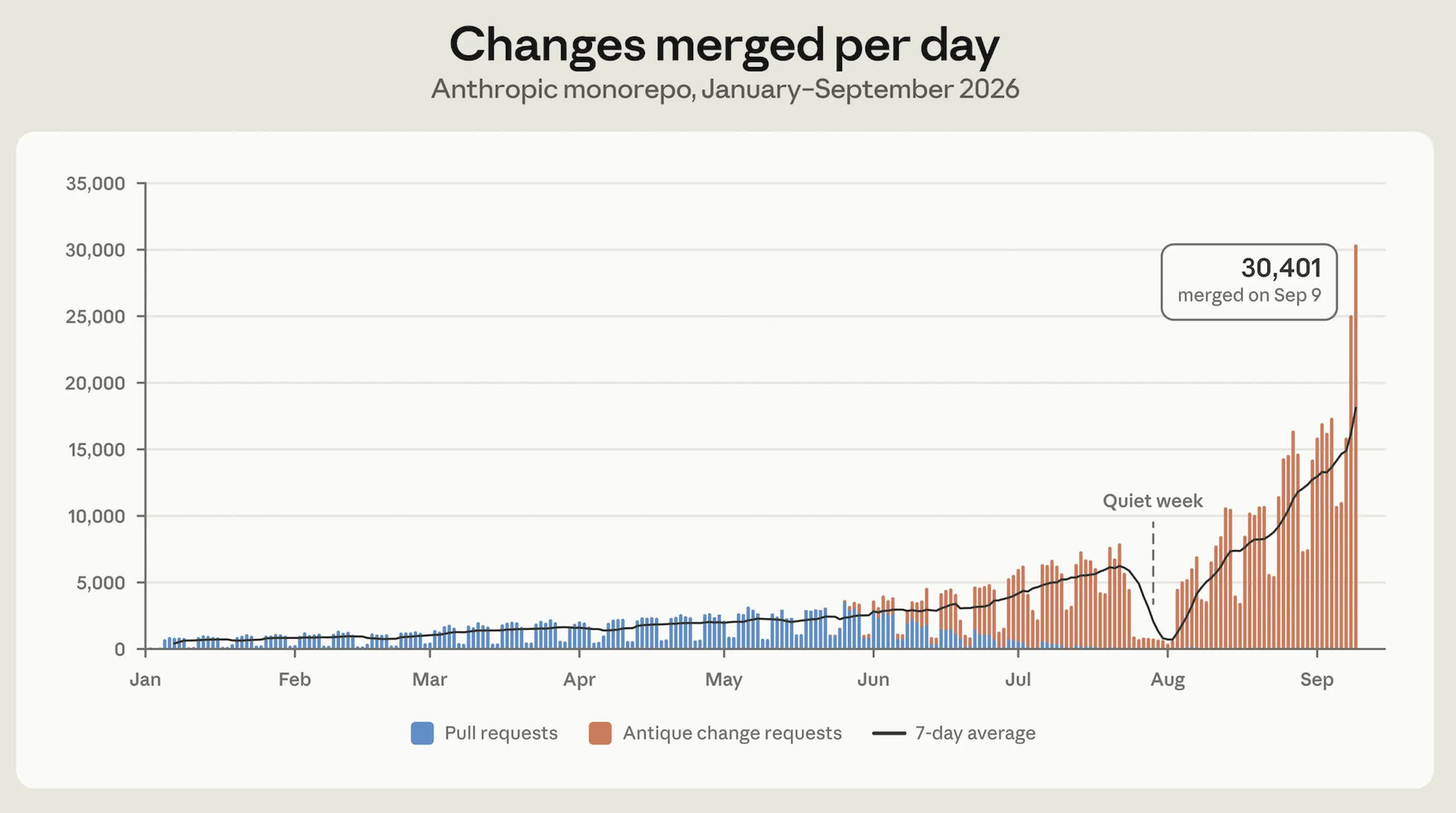
One AI example from just this week shows AI's scaling effect: Anthropic built a code management system because its Git system could no longer keep pace with the number of pull requests submitted by autonomous agents working on complex software. Git source control was built for humans, not machines. Anthropic's software developers no longer write software; instead, they oversee many agents who do. In Chapter 2 of The Technological Society, Jacque Ellul noted that technique grows geometrically, as each new breakthrough opens new possibilities. AI is nothing if not the perfection of technique because it produces the same effects as a well-organized, disciplined mind, but with much greater power and intensity.
Organizations seem unaware that writing, testing, merging, and deploying software manually is already obsolete, and that companies across the West now pay many thousands of humans above-average salaries to do it. (Buggy makers were already obsolete the moment Ford Model Ts began rolling off of the first factory floor in Michigan. Technological gaps close very quickly.)
Yet, the political class also seems unaware of what is underway, or chooses not to show its own ignorance in public debate. Whereas the U.S. consciously chose to de-industrialize in the 80s, a few frontier labs are imposing today's new technology shift on the entire global system. It is increasingly clear that humans are no longer in control, or, at the very least, they do not understand how far things have gone already. Corporations are locked in a Mexican standoff, eyeing competitors, waiting to pull the trigger on reorgs and layoffs because the future is so unclear.
During the transitional years to the new global capitalist system, engineers from American universities entered a job market that no longer needed their skills. These graduates often ended up in managerial tracks, their degrees largely wasted. The Western vision of a new global financial architecture saw "service jobs" replacing the dirty, unsafe, capital-intensive work of building local factories and distribution centers.
Today, increasingly autonomous Chinese factories rely on robots to produce electric cars and consumer goods, and Western stories of Chinese factory workers throwing themselves off buildings no longer circulate in the media because they no longer happen; Americans have Uber drivers and Instacart shoppers whose greatest challenge is avoiding death by boredom from long sits in gridlock.
In other words, the Chinese accepted short-term misery in human-operated factories and later capitalized on their learned experiences to remove their own citizens from the equation altogether. Western elites, in contrast, were unwilling to sit through the transition to automation for a few years, preferring instead to sacrifice the working and middle classes for short-term profits, which they then used to inflate asset values, making homes and higher education debt pits for the young. American workers still have dull, boring, tedious jobs of their factory-worker forebears, but with ginormous credit card bills to boot. The waitress who walks hours a day delivering plates to hungry guests is still working on an assembly line.
To put it plainly: The West peacefully and happily dismantled its own industrial system so that by the COVID outbreak in 2020, it could no longer produce even a vitamin C tablet domestically. Its dependency has been most evident in military and AI technologies in recent years. China's strong energy portfolio, including a blend of coal, renewables, and nuclear, has positioned it as an AI development leader because its LLM training costs are significantly lower. Data center construction there faces fewer barriers than in the U.S., where a fossil fuel-based legacy grid reliant on aging power plants is woefully inadequate for the pace and demands of AI scale-out.
Whatever profits came from the Western capitalist class's wholesale destruction of its industrial base went directly into their pockets. America continued to act as the world hegemon, starting new wars and racking up unpayable debt to fund, among other things, its weapons industry and foreign military adventures. The power grid and infrastructure more generally were left to decay. Much of rural America today looks like a developing country.
FC anticipated the Chinese scenario (§196) and saw it as desirable because technology interdependence creates a single point of failure. While this failure point is the obvious target of an anti-technological revolution, it could just as easily be exploited by a devastating plague (planned or not) or an unforeseen environmental calamity. If China goes offline even partially, the entire Western technological system would collapse, leading to mass die-offs as supply chains shrink and essential goods disappear. One future lab leak mishandled in a Chinese city would cripple large-scale organizational technology, sending societies (à la Joseph Tainter's The Collapse of Complex Societies) scurrying back to more primitive organizations of survival. It would take generations to recover anything like the global free trade of the past few decades. In fact, it would be a new Dark Age.
(In his book Technological Slavery: Volume One, Kaczynski entertains the lab-leak scenario that kills one-third of Earth's population and dismisses it as a possible locus for revolution, since people would blame it on one accident, not the technoindustrial system as a whole (p. 146). Here, I'm pointing to industrial output disruption on a scale that could collapse the global supply chain as a side effect of the leak, and that would take years to repair. Immediate death from a deadly biological agent would be compounded over years by starvation and political instability.)
AI dependency exponentially worsens this vulnerability. Consider America in five years, and pretend the grid can somehow support data centers in every nook and cranny. What happens if an EMP weapon is detonated at high altitude over the Midwest? Or suppose 1859's Carrington Event happens again, after the switchover to an AI-based civilization?
The current grid isn't designed to withstand these possibilities; if automated logistics, shipping, and manufacturing systems lose communication and power at the same time from an extreme, widespread discharge, the consequences would be severe. An EMP isn't a simple hiccup that makes the lights wink out for a few seconds. Instead, it damages large transformers, which can take years to replace. In truth, no one really knows how serious the damage would be, or how long it would take to rebuild after an EMP. Meanwhile, the automated factories needed to rebuild damaged components would be offline or at reduced production capacity.
And those refrigerators? What of them?