Sitting this one out

The U.S. provided at least $21.7 billion in military aid to Israel in the two years after October 7, about $17.9 billion of it under Biden. This helped Israel keep up its military campaign in Gaza.
I considered voting for Team Blue this November. I've never really voted much, and I don't buy into it as a way to change anything. If other people choose to vote, it's their business, and I don't criticize them for trying to make a difference.
I briefly, depending on how you define the word, considered going Blue as a lesser-of-two-evils approach to the current administration's disastrous handling of almost everything it touched over the past two years. In 2024, I was pretty sure the Blue Team was off its rocker, but in 2026, they seem sane and reasonable. That's how bipartisan politics works, though, and it's why I will not play the lesser-of-two-evils game.
It makes sense for a practitioner to examine his mental states carefully regarding politics to understand what makes him vote. The Tangle advises voters to watch their hearts, see the swirling, and see their choice, and their fellow citizens' choices, as products of causes and conditions.
If casting a ballot matters to you, go into the booth and mindfully choose what you think will reduce your fellow creatures' suffering. If you dislike a candidate, his party, or his followers, remember that they are, like you and me, delusional creatures who are suffering. The winner's power will bring more personal suffering, discontentment, greed, and delusion on a scale that dwarfs what you and I experience as ordinary voters. Winning a federal election means the victor's chances of ending up on the ass-end of a freezing hell realm are really, really good.
"There but for the grace of God go I..."
Therefore, the politician given power who turns a blind eye to suffering when he can ease it invites the fruit of his intentions. Do not let his bad karma become your bad karma. Do not take ownership of this issue or that issue. It's not self; it's not worthy of self. Views and opinions fuel becoming. But do not be indifferent to things. I don't believe there is a good reason to expect a different result by casting a vote, but if you do, know what is going on inside yourself first. You can still write your representatives a thoughtful, sincere, and polite email explaining your position on issues. That's closer to agency than casting a ballot.
Voting involves aversion, or aversion with clinging. If you vote against a party, but not for the other party, then you are practicing simple aversion. You do not cling to this party; you just don't like that party.
Aversion and clinging are the classic partisan stance: I like this party better, and I generally don't like this one because it does X, Y, and Z. This traditional binary reflects a divided mind.
Most American voters, however, are independent and don't consistently follow simple aversion or the dualist format strictly.
About 40-50% of the adult voting population is emotionally affiliated with the bipartisan system because they believe the two parties differ and that their platforms represent really different worldviews. The larger segment of independent voters may lean one way or the other, but generally choose based on the candidate and the menu of policies they support at a point in time. Commentators during election cycles often talk about the swing vote because it's unreliable and unpredictable.
A very large block of the potential electorate, let's say around 50%, simply does not vote at all. This can vary depending on how intense the economic issues are. Maybe 60% turn out if the economy really sucks. Activating the military draft would also send people to the polls, but that's unlikely since even the incompetent political class knows there are limits. Americans aren't ungovernable, but this would push them in that direction.
I've not seen politics solve anything in my lifetime, and voting has had no perceptible effect on the rate of decline. If I vote, I do so knowing traditional partisan politics can't fix the problems it created. I validate a system that cannot but do evil, and the fine mental slicing and dicing of degrees of evil doesn't change that. I agree to participate in an illusion.
When the Gaza massacre started, I wrote my federal representatives. I followed up this year with another request that they do whatever was in their power to highlight the plight of Gaza and to secure peace and restitution for the survivors living there.
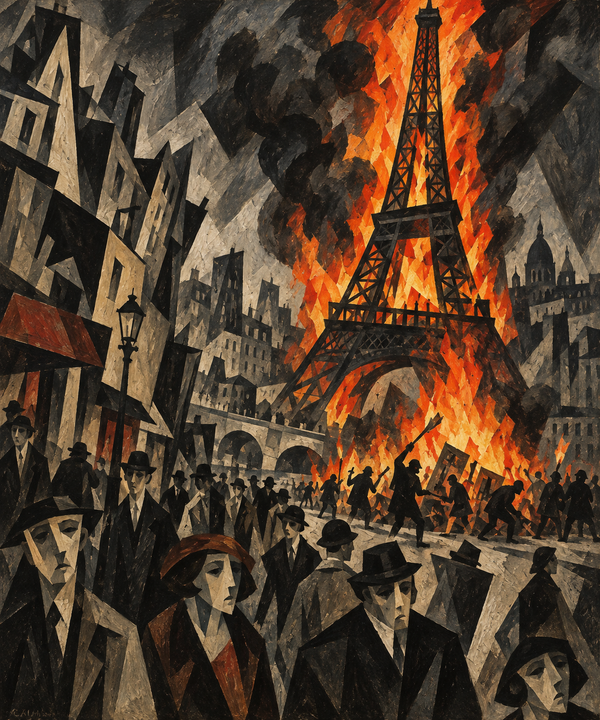
In the 90s, I saw where things were headed and, if I could see it then, then presumably those more powerful and smarter than me in the political arena did as well. For decades, we've sat on our front porch smoking cigarettes and drinking coffee, watching the semi barreling down the road toward our home. Applying Zeno's dichotomy paradox, the truck will never reach us. We are fine. Everything is fine.
The Roman statesman and orator Cicero said it best:
Systema est quod systema agit.
The system is what the system does.
I jest. Cicero never said this, but the idea is pretty good because it reflects ordinary people's experience with "the system." Cicero would've understood the sentiment and developed it further in a rich oration.
Failing political systems produce a sense of resignation in the population: the system, like a fussy, angry toddler, just has to wear itself out. Keep your head down, focus on your little world, and do what you can to influence the situation around you. Right now, later-period decline looks like people have fully retreated from social engagement and are waiting it out. Powerless people do the sensible thing.
I believe someone who had lived through the last days of the Soviet Union would understand the West's present ennui and hunker-down mindset. "Happy families are all alike; every unhappy family is unhappy in its own way" (Tolstoy). I don't think this is true for failing nations. I suspect the feeling tone is the same no matter the form of government or the culture in its final stages.
How many of us are real influencers (not some floating head on social media) or know someone personally who is? In smaller communities of bygone eras, you were probably only a few degrees from a mayor, local businessman, or other meatspace influencer. You had someone you could voice your ideas to and, in turn, move things, or at least be heard directly. No, they weren't objectively powerful, but they were tangible influences on your immediate world.
As a person, you could make something happen by nudging another agent in a certain direction. That was a kind of "power" if you choose to stretch the word. Community events and formal civic organizations gave little agents outlets to do small things that made life feel connected. Hunter-gatherers lived in this dream-like world for millennia. Social agents, environmental agents, animal agents.
Social media in hyper-capitalism is hyper-real. It never really leads to major political change or social improvement because it just increases isolation, and those in isolation sit and watch. The hyper nature of modern life makes it feel like things are happening, and they aren't.
Local newspapers are dead because the local community just isn't worth reporting on. Drug busts, DUI arrests, obituaries, the like. Nothing ever happens. Deep investigations into corruption, thorough reporting on water treatment and conservation, traffic planning, and so on were seldom found. Little newspapers died. No one wanted to speak truth to local power because it sucked out ad dollars from the till.
A free press tied to the local market for its survival has to bite its tongue when corruption sits in plain sight. "It is difficult to get a man to understand something when his salary depends upon his not understanding it" (Sinclair). Local newspapers did not want to understand things. Before the Internet (and after its initial adoption), it was easier to stick to church news, mug shots, weddings, and obituaries. Everyone is happy. Reporters keep their jobs, businesses get their ads to a wider audience, and citizens remain uninformed and therefore, calm. Nothing too terrible to get upset about.
Of course, they still went out of business or were absorbed into conglomerates whose idea of local news was running generic wire stories from AP or Reuters, plus the weekly drug-bust lineup. The growth of the Internet meant all problems became global problems; global problems don't have meaty agents bumping into each other at local gatherings and exerting agency to affect outcomes. It's floating heads, first on cable news, then on 10 billion YouTube channels.
The real reason for sitting out the 2026 midterms for me personally is that the previous Blue Team, whose leader was President Biden, provided seed money used by Israel to destroy Gaza physically while killing tens of thousands of its inhabitants. The rest of the Blue Team stood by mostly silent, and yesterday marked the third anniversary of the attacks on Israel, which, in turn, triggered the massive humanitarian crisis in Gaza.
The Blue Team did nothing besides fund the first genocide of the 21st century. By "fund," I mean money, materiel, and moral support.
When Red Team swooped into power in 2025, they didn't change the policy; they scaled it up. Emergency arms sales that bypassed Congress were delivered lickety-split to Israel. The horrible images out of Gaza kept being served over the streams, and the passivity hardened. Criticism grew more vocal in 2026, but it seemed perfunctory and empty, another insincere display typical of techno societies. Gaza was already rubble by the time of the Macklemore incident a few weeks ago. Artists had three years to see something, say something.
We are used to violence and cruelty in movies and TV, so streams of real people suffering in a real place are served through the same medium as Alien, Kill Bill, and Full Metal Jacket. The mind enthralled to digital images doesn't separate the real from the unreal. An advertisement for dandruff shampoo between segments on the Gaza massacre on cable news lands the same way.
Nothing ever happens.