Western Buddhism - A Ramble


The West is a meat grinder. Whatever you feed into it becomes chewed up beyond all recognition, fit only to be wrapped up in plastic and then slapped in a refrigerated counter under fluorescent lights.
One of the questions that comes up among Westerners re: Buddhism is the latter's stance on homosexuality. Sodomy is a very big deal to Westerners, especially white people, so they want to know where this alien religion stands in relation to the burning question of our time.
The West is probably the only culture that has come into contact with Buddhism in the last 2500 years and has had as a top five concern the place of homosexuality and transgenderism. Imagine Tibetans in the 8th century hearing the dhamma and questioning Padmasambhava:
"But what's your stance on biological men wearing women's clothes and having anal sex with other men? What are your pronouns?"
One man ejaculating into another man's feces is not just sodomy, BTW. This is a very primitive, limited take on the practice. We've come so much further. The modern West is obsessed with sodomizing women as well and with men being sodomized by women wearing strap-ons. Sodomy is inclusive, as is everything properly Western now. No child is left a behind.
Homosexuality has been around in every culture; it's just not clear how much value was placed on it in places like Burma, Sri Lanka, and Thailand. In the Pali Canon, I've not found any mention of it. Meaning, I've read a lot of suttas and cannot recall it ever being mentioned, but there are thousands I've not read. If you've read a lot of suttas, it means you have made it through 3% of the texts.
Internet searches don't turn up anything either. The Canon mentions quite a lot about people's daily lives, usually to illustrate a dhamma teaching. Weaving, butter making, fletching, preparing/storing legumes, etc. The Buddha and his disciples cared about people and went out of their way to make the dhamma clear by linking it to activities and objects of ordinary life. Jesus did the same thing 500 years later in his ministry.
When the dissection of the West's cadaver takes place, I suspect that the celibate clergy of the Latin Church will figure prominently in the creation of a homosexual cohort within the upper echelons of society. It's been sitting there for centuries in plain sight and has, along the way, developed, as any organism would, protective adaptations. I think the many decades of ephebophile clergy being shielded by their direct reports shows how this clique has operated. One of the copes you will hear states that the infiltration of the Catholic clergy by homosexuals is a communist tactic devised in the early part of the 20th century, as revealed by insider Bella Dodd. Before then, the Catholic priesthood attracted straight men, and there were few problems.
I wouldn't be surprised if something similar didn't exist in the East, in the tonier Buddhist temples patronized by more affluent monarchs. A coterie of effeminate monks who found life in the sangha and the company of men more to their liking than having to get married and start a family.
Forced celibacy and all-male communities seem to go hand-in-hand with a homosexual subculture, yet it's not apparent from the outside whether the Buddhist version, if it exists to any extent, has had the same degree of influence as the Catholic variant in the West. Is there gay Buddhist art hanging in ancient temples? Were 14th-century artists in Thailand depicting men in embrace?
Do Buddhist practices like jhanna, corpse meditation, and maranasati give Buddhist clergy an advantage over their Western counterparts when it comes to certain temptations? I tend to think so, but it's pretty clear that monastic norms and disciplines can vary between time and place. Laxity in practice provided impetus for the Thai Forest tradition, which can be seen as a reform movement that repudiated the abandonment of meditation and monastic discipline. Still, for people who regularly enter first jhana, there is an effective buffer against physical sensuality.
If we direct the question about sexual art to Tibet, then yes, there are dick pics in the Himalayan region where tantric Buddhism is practiced.
Tantric practices are among the Hindu spillovers into Buddhism that can't be found in the early Buddhist texts, although Theravada is reported to have adopted some of them. Religious syncretism was especially potent in this part of the world, and the indigenous religious and cultural ideas of the mountain peoples did not disappear with the arrival of Buddhism.
Pro tip: Whenever you see the word "esoteric" in relation to any religion, it usually means shit someone made up to rationalize things he wanted to do but couldn't because of a standing conflict with the exoteric doctrine.
Thus spoke the Venerable Ananda, but the Blessed One answered him, saying: "What more does the community of bhikkhus expect from me, Ananda? I have set forth the Dhamma without making any distinction of esoteric and exoteric doctrine; there is nothing, Ananda, with regard to the teachings that the Tathagata holds to the last with the closed fist of a teacher who keeps some things back.
My digression into esotericism like that found in tantrism aside, sensual art is not part of every school of Buddhism, and even when it is, it isn't Buddhist in origin. Bhutan loves dick pics and is nominally a Buddhist nation, but it's the only one that posts them all over the place. Their use is tied to practices from the dormant Bön religion reinvigorated by a Mad Monk. Bön: The religion that keeps on giving.
In Western religious art, there is gay stuff. Or weird stuff. The artists themselves may or may not have been gay, but they were likely patronized by gays – maybe even entire episcopal conferences of gays – for some of their works. This is not limited to the modern or Renaissance periods either.
Catholicism, the dominant body in the West historically, is the only form of Christianity that posts dick pics in sacred worship places. Not in every parish, of course, or even most. To me, this is the way in which the gay clique expresses itself as a presence in the Body of Christ over the centuries. Think of it as clerical graffiti, a way of saying "We're here, we're queer and we run your church!" but in a way that doesn't get them burned at the stake. Recall that the Knights Templar were stamped out almost overnight on charges such as practicing the love that dare not speak its name. Seriously gay religious pictures can be sort of rationalized as something artsy-fartsy that elevates the spirit to God.
Dick pics do not show up in the Orthodox Churches, which have a married clergy. Bishops and monastics are, of course, celibate, but the majority of the clergy are not; therefore, the culture is very different. Straight men, as a rule, are not comfortable around dick pics and would not go into a profession where they had to stare at them in the workplace. Even homoerotic images of St. Sebastian would be off limits in Orthodoxy for the reasons Fr. Strickland gives in an interview with Joseph Sciambra.
This brings me to Western Buddhists and the Gay Question.
Buddhists in the West have cultural baggage which shapes how they look at homosexuality and sexual ethics. The West is imbued with a sense of law: our international rules-based order, our system of laws, our human rights recognized by legal bodies, ethical laws, natural laws, laws of physics... the list goes on. We believe in these laws even when they are toothless, absurd, flagrantly violated, or no longer relevant.
The largest piece of luggage in the collection is Yahweh, the Author of the Law and the Being who revealed the Decalogue to Moses. This idea of Law and Law Giver is crucial to understanding how Westerners look at moral questions, including those of us who go East to the Buddha for refuge. There's a cultural filter Westerners wear when they look at the Buddha's teachings (self included).
What's the rule? When was the rule given? In what rule book?
For the Western Buddhists, the rule books don't treat homosexuality as taboo. The Sutta Pitika doesn't mention it explicitly; the Vinnaya (the monastic code) does. The code doesn't have any bearing at all on the layman and so, under the rubric "There is No God, Therefore All Is Permitted," Buddhism is seen as permissive or indifferent to the question of laymen engaging in same sex relations so long as it is in the context of the Third Precept. Even that, of course, is situational since one of the glaring issues with the West and its many laws is that they are all provisional, ad hoc, and arbitrary. Western society produces rules, regulations, and laws on an industrial scale such that the whole concept garners little respect. Julian Assange has been rotting in jail for over a decade and has not been charged with any crime whatsoever. The modern American city has the feel and reality of lawlessness despite the eye-watering amount of money spent on concocting new laws.
Turning back to the realm of personal ethics.
I undertake the training precept to refrain from sexual (sensual) misconduct.
Interestingly, sensual misconduct is defined in relation to a man's act:
He engages in sensual misconduct. He gets sexually involved with those who are protected by their mothers, their fathers, their brothers, their sisters, their relatives, or their Dhamma; those with husbands, those who entail punishments, or even those crowned with flowers by another man.
He cannot have a woman sexually who is betrothed ("crowned with flowers by another man") or otherwise under the guardianship of a relative or a religious vow. In most ancient cultures, a woman was either under the protection of her family, a religious community or her husband. Women living like Carrie Bradshaw in Sex in the City were not found in this world. They were not free agents. In a similar vein, women living alone in the more recent Puritan settlements of New England were treated suspiciously and sometimes persecuted. Lone women today are still picked on as crazy cat ladies, although much less so as the number of spinsters continues to rise. The word "spinster" is now archaic.
To repeat: one will look in vain for references to homosexuality in the Sutta Pitaka. Jackson's article "Non-normative Sex/Gender Categories in the Theravada Buddhist Scriptures," linked to earlier, references only the Vinaya, the monastic code. If you were trying to build a case for gay Buddhist weddings, you would have zero material from the tradition to use as a basis. The Vinaya in Jackson's brief outline discusses "non-normative" sex in terms of a classification system. As a Westerner, he could not use the word "unnatural" for fear of cancellation.
The Suttas do give guidelines regarding right conduct in sex, as the quote shows. It does not say you can rape a widow who lives alone, ejaculate into another man's digestive tract, or masturbate to your heart's content; the passage is concerned with sensuality as it relates to natural relations between men and women. It also doesn't discuss overeating, retail therapy, obsessing over the finest clothing, or indulging in other sensual pastimes.
This gets at an important difference between the Western approach to life and Buddhism. The dhamma, understood as a formal teaching, invites the student to cultivate mindfulness and to avoid activities that lead to sensual indulgence and gratification through empirical observation and reflection. Sensual indulgences are active forms of the kilesas which can harden the mind into unskillful patterns of behavior, causing spiritual blindness along the way. It's easy to forget the Three Marks if you are entrapped by the senses.
For monastics, to practice the dhamma fully as delivered in the current dispensation is to renounce worldly pleasures and place oneself under a strict code of laws which governs every detail of daily life. I confess to knowing zero about the Zen tradition of monks marrying and having kids, as Kodo Nishimura's folks did. Celibacy appears optional in the Mahayana tradition along with alms rounds, money handling, and other activities forbidden by the Buddha to his monks. This is to say that the code's pretty flexible depending on the school, much of it owing to hard constraints encountered with the spread of the faith.
For the laity, we lead a more sensual existence, but that does not mean we are free to live profligately, giving ourselves over to impulse, because we lack a formal ethical system like that of the Abrahamic faiths. "Thou shalt nots" are expressed differently in Buddhism and are taken as the ground floor only, not the summit. These hide the true depth of ethical commitment that practitioners must make if they are to progress spiritually.
If you don't believe me, try living mindfully for the next ten minutes. It's hard. That's why there is daily formal practice of sitting and walking, to train ourselves to see the movements of mind and body. If you are observing closely, you can see flashes of anger, greed, or lust from miles away before they strike.
The Noble Truths include Right Livelihood – the ethical commitment to avoid any profession that involves inflicting suffering on other beings, such as selling alcohol. Christianity and Judaism have no such teaching. If you want to sell booze, you can. Jesus' first public miracle was turning water into wine at a wedding. Make of that what you will, but the Buddhist finds the locus of action in the possible harm that is caused as a result. Harmlessness in Buddhism is a compliment in the Pali Canon, an indication that someone is attentive to the possible suffering they may cause through what they say or do. Giving wedding goers large pots of wine – a poisonous intoxicant – is harmful even if no commandment from God forbids it.
To go deeper: There's a reason that there are Five Precepts and not Ten Commandments: Dhamma students know that coveting their neighbor's wife or property is bad karma. Alertness to the contents of our own thoughts and how they lead to right or wrong action means that the onus of ethical behavior rests with us, not externally in the commandments or the grace of a deity. We know, and others perceive, the fruit of our efforts by what we say and do.
Dhamma does touch on natural law, but not in the Western sense. Ancient Indians seemed to have very little interest in the workings of observable nature, so placing the homosexual act in terms of teleological ends of the various body parts would've been alien. "This hole secretes solid waste and is not intended to have things inserted into it because of disease, future incontinence, plus other unsavory side effects" is a statement that probably would not compute to an ancient. Modern Westerners share the same lack of interest in nature but for different reasons.
Instead, Indians followed other ancient cultures, placing sexual acts in terms of masculine and feminine, active and passive agency. Using modern terms, bull dykes would be seen as manifesting a dominant masculine quality while twinks would be thought of as feminine – the biological form would just be the vessel for these primal psycho-sexual forces, the do-er/receiver, yin/yang models of gender. This is a pre-scientific psychological framework that gives ontological priority to phenomena, mental forms, and ideas, not "things." If we could take on the perceptual reference of an ancient for a day, we would be shocked at just how different they were from us now in certain key respects. Material reality was a distant second to the default setting of Idealism.
Joseph Sciambra writes with extraordinary candor about his life as an active homosexual youth in San Francisco. He talks about the mechanics of being a gay man that helps us understand the commitment involved, the sensuality, and the broken psyches that drive the subculture.
For women, the eroticization of the pre-sex process prepared their bodies for possible penetration. No such mechanism was at work in the anus of a man.
For Westerners reading this, allow me to explain.
What he is saying is that women get wet naturally when aroused in the part of their body evolved to capture the seed of a man and grow a baby. It's also a part of the body that provides sexual pleasure to both a man and a woman during coitus. Thus, unlike gay men, they do not have to buy enemas, flush their digestive tract, and then lube their anus before sex, as Sciambra describes having to do when he was still active. It comes naturally for women.
Sciambra's stories are not unusual: statistically, the average gay man has a high number of sexual partners, and he discusses the behavior of gay men in San Francisco in detail, the diaper wearing and floors slick with the semen ejected by groups of men in hookups.
It deserves mention because in the West, there was a pretty serious effort on the part of corporate capitalists, white women, and older gay men to make gay marriage legal in all 50 states so that it looked like heterosexual marriage. Life-long commitment, stability, home ownership, joint checking accounts, laws of inheritance, and other bourgeois values.
In the Aughts, corporate sponsorships of Pride parades and gay marriage legalization backing were seen everywhere, especially if you lived in a city. You couldn't escape the corporate ties to anything and everything gay. Corporations gave money to back pro-gay marriage candidates, extended same-sex benefits to employees, and so on.
Beneath the rebranding, however, gay men are still interested in sex with lots of different male partners. One Redditor commenter puts it this way:
I could order from every single pizza place there (sic) slowest business hours give them a 10 minute head start and then open Grindr and my blowjob would still arrive before my pizza every time. This has been tested by a friend.
One 2017 Gallup poll put the number of gay adults who are married in the U.S. at 10%, two years after Obergefell. Four years later, in 2021, it's still steady at 10%. This suggests that marriage is not such a priority for gay people. Why would it be if sensuality is the point? The plans to domesticate homosexuals and turn them into jez folks don't appear to be working.
I talked to a retired scientist one night over dinner about his decision to get married to his same sex partner. I asked, "What made you do it?"
Most gay men, when you get to know them, will give you the details about their sexuality. Most of them are very patient and candid if they understand you are genuinely curious and non-judgmental.
"My accountant said we would get a boatload of money back during tax season."
Then he tried to talk me into going to the mens room with him and I declined.
Both he and his partner had been together for decades, but it was clear from our conversation that their arrangement was open. Sex is the point of the gay lifestyle, and it was only in old age and on the advice of an accountant that marriage gained any appeal. His partner was like him, educated, well-to-do, and between them, they had a comfortable life that included adventures with other men. In old age, one wants a sense of security as the body begins its final march to break up.
But is open marriage covered by the Third Precept? Putting it this way sounds legalistic, very Western. Nevertheless, it suggests that the hooking up of the gay subculture – made easier with the appearance of apps like Grindr – is not really consonant with the demands of lay Buddhist practice. If we jettison Western natural law considerations of gay sex and try to stick with a classical Indian Buddhist view of the matter, it's very difficult to see how a lifestyle that warrants no mention in the early texts and which involves promiscuous behavior is authentically Buddhist. Normal heterosexual marriage is mentioned frequently in the texts. The Buddha was married, and he had a son. His lay followers were married.
Buddhism in the West is predominantly the interest of educated, white, aging liberals. (I don't see Buddhism holding much interest with the youth.) Most of these Boomers see Buddhism as antinomian, an antidote to the legalism and sexually repressive rules of a Christianity that exists only in their minds. It's been de-mythologized, enervated of core ideas like karma and rebirth, and turned into a therapeutic regimen for neurotic urbanites. In other words, it is conditioned by the materialist perspective which has prevailed in the West for the past four hundred years.
Bön & Hinduism made inroads through Vajrayana, and something like a syncretic process continues between generic imported Buddhism and the West's atheistic materialism. The major schools all gained a foothold in Europe and America in the 20th century, with Mahayana having the upper hand in terms of popular reach. Everyone has heard of the bodhisattva vow.
For a niche group, Buddhism provides ethical guidance for living a better life with meaning beyond the weak materialist foundation of Western civil society. The identification of Buddhism with LGBTBBQ in the West is most unfortunate since this muddies the dhamma, forcing it into the mold of Western consumerist values. The whole planet has homosexuals and always will, but in the modern West, the subculture has taken on the role of a powerful cult that, as with the celibate priesthood of Latin Christianity, seeks to ensconce itself in another tradition, one which values celibacy and renunciation.
The last sentence sounds pretty paranoid, admittedly, but only until you start searching the Internet for stories about Western Buddhism and see it linked with LGBTBBQ activism. I've even seen a white female posting as a bhikkhuni with neo-pronouns. There are plenty of articles covering the "identities" of Buddhist and gay, or Buddhist, gay and immigrant. The value placed on identities and identity-building is at odds with the practical Buddhism of the early texts, which warned against such a habit. Our conventional selves come with a set of characteristics that are impermanent and the cause of dissatisfaction. Attaching to them publicly in front of people who are ignorant of dhamma is not a skillful presentation IMO.
I don't see Buddhism as having much future in the West. For decades, it has been mostly lay-led, turning into its own industrial complex and showing little impact on the culture, all the talk about secular mindfulness training notwithstanding. Stephen Batchelor has undertaken the mission to redefine the Four Noble Truths as stuff about tasks; Jack Kornfield has vouched for the oligarch Sam Altman as having a good heart; WEF critter Yuval Noah Harari is really big on Goenka, and it's done nothing to enhance his charm.
Lots of money flows into the trendy retreats, books, seminars, meditation classes, etc. produced by the complex. Buddhism in the West looks like an upscale boutique business for Boomer yuppies. It would be unfortunate if some of the more popular exponents of dhamma were multi-millionaires as a result of their work.
Theravada monasteries exist in Europe and America, but it's not clear whether they could maintain the almsgiving rules in the absence of their immigrant communities. The Thais and other communities will be assimilated into their Western host societies and will drift away, the victims of a bland, consumerist, or maybe soon-to-be war-torn secular society. Contrary to popular belief, the immigration pipeline will not last forever.
It's hard to see how these monasteries can survive in the event of a severe economic downturn, war, or another seismic event that causes the supporting lay communities to retreat to their original homelands. America is in sharp decline and with each passing year, this becomes more apparent to people considering emigrating from Southeast Asia.
Buddhism wouldn't have survived in the absence of wise monarchs, who stepped in at key moments in its history to give the sangha shelter from violence and persecution. Democracy tends towards degeneracy and collapse, and right now, the whole world is in its death grip. What dhamma has made it into the Occident is already vitiated.
The West is not fertile ground for anything spiritual at this moment. The death of the petrol dollar and the fantasy world it has allowed America to enjoy at the expense of the rest of the planet will vanish shortly, leaving a void that will be filled by many unpleasant things. It may be that a Future King will restore dhamma through his patronage, but it will probably not be in the West. Europe's destiny lies with Islam, which will begin reintroducing whites to basic morality over the next few decades. America will fragment into any number of petty squabbling states and who knows what, if any, spiritual roots will take hold.
I'll close with a quote from Wiki on the history of LGBTBBQ in India:
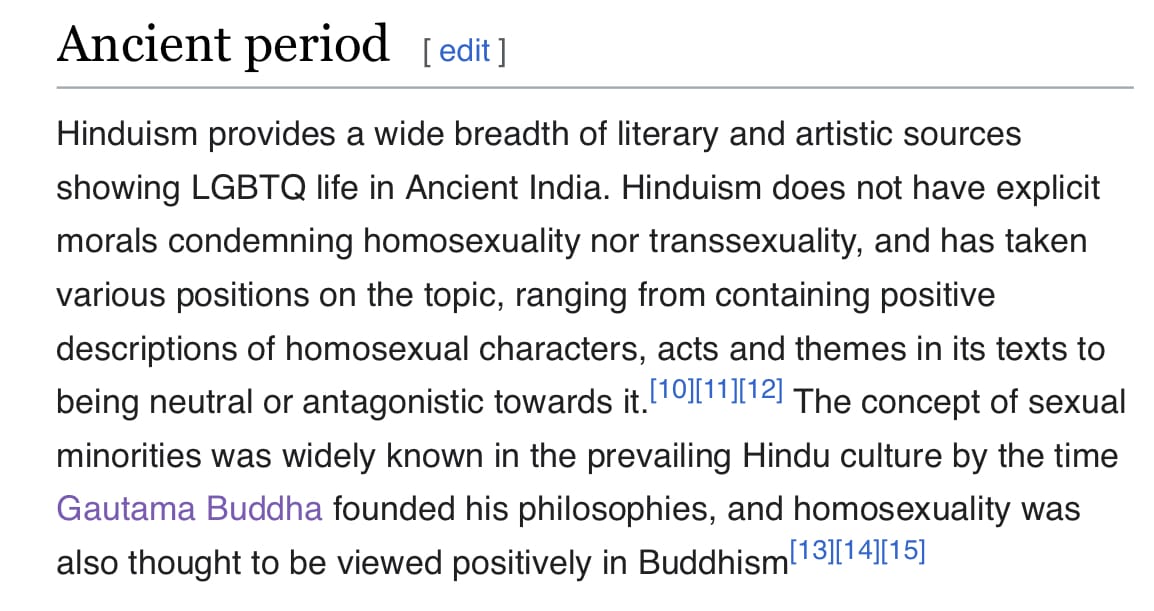
There are three citations in the last sentence. One is to Jackson's article mentioned in this blog post. The other two have absolutely nothing to do with supporting the claim that is made. This is revealing because whatever one thinks about homosexuality's compatibility with Buddhism, there is dishonesty in how it is presented in the West because there is no interest in it in the Tipitaka. (I set aside the Wiki's claim that there was a "Hindu culture" at the time of Shakyamuni and will blog about it later.) Likewise for the Vinaya and Abhidhamma literature. Thousands of pages of texts and nothing affirming, praising, or supporting homosexuality or cross-dressing.
The Tathagata preached suffering and the end of suffering in this life, not affirmations of identities and self-views rooted in sensuality.
If the Lord Buddha was about affirming the identity of sexual minorities in his time, there would be actual supporting citations, and they would be all over the Internet and cited by activists ad nauseam. But the Suttas, thousands of them, are directed towards transmitting the dhamma, for the ease and liberation of creatures enslaved in sensuality.
In the Talaputa Sutta, the Blessed One is approached by an actor who wants affirmation of his identity. Surely the man says, I will find myself one day after death in the company of laughing devas in heaven on account of my acting, right?
The Buddha listens as the question is repeated a few times before answering. Like most homosexuals now, Talaputa wants his view of himself to be blessed by others, especially if they are influential and well-respected. He is seeking acceptance because he knows, deep down, that his livelihood is wrong. It's rooted in the laughter and delight stemming from the "imitation of reality."
'When an actor on the stage, in the midst of a festival, makes people laugh & gives them delight with his imitation of reality, then with the breakup of the body, after death, he is reborn in the company of the laughing devas,' that is his wrong view. Now, there are two destinations for a person with wrong view, I tell you: either hell or the animal womb.
When this was said, Talaputa, the head of an acting troupe, sobbed & burst into tears. [The Blessed One said:] "That is what I couldn't get past you by saying, 'Enough, headman, put that aside. Don't ask me that.'
Talaputa is uplifted by the Lord's dhamma and goes on to confess that he is a lost one who has been recovered by the truth.
Western Buddhism will not uplift anyone if its teachers and lay leaders continue to use the morals and underlying assumptions of an empire in late decline to distort the dhamma. People who would benefit from hearing the dhamma will turn away when they see the same bilge about sensuality being an "identity" mindlessly repeated by Buddhism's representatives in the West.