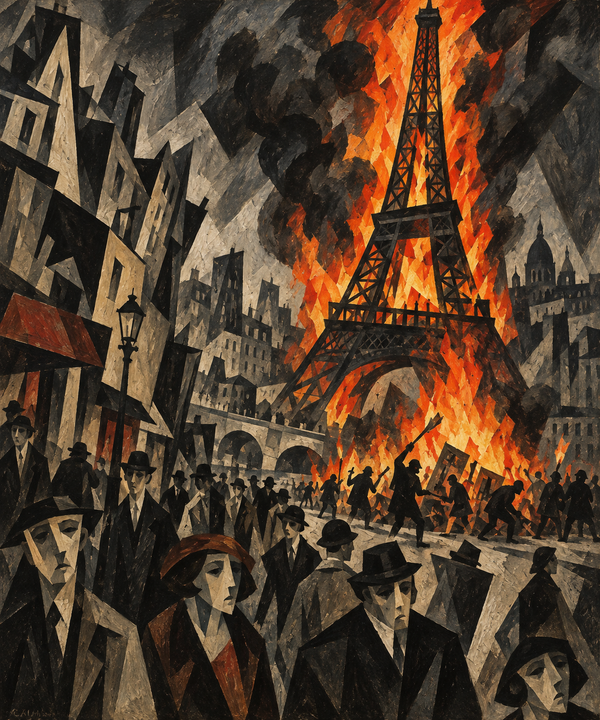
Waiting for the anti-Christ, pt. 1


This is probably my most ambitious rambling blog entry ever...
The spectrum of feelings and thoughts I have about Christianity ranges from appreciation to disappointment to perplexity.
Of late, I've become especially negative towards Yahweh and his various schools, and whereas in the recent past I could cobble together some positive remarks internally on the Christian faith and its benefits, when Israel responded to October 7th, whatever goodwill I had towards Yahwism (my term) vanished. Hanging by a thread one moment, then snip.
One important change I made in my thinking about the Abrahamic faiths is to refer to Yahweh rather than god. Yahwism has benefitted beyond all measure by cloaking itself under the general name "God." In fact, this god is like all gods, a product of causes and conditions. Biblical scholarship and criticism over the last few years have solidified my belief that we need to relate to the Abrahamic schools by using the names given, lest we slip into the God theologians and philosophers talk about. Yahweh, Odin, Zeus, Krishna, etc. No one gets special treatment here. Take a number, get in line. You are one in a long, long line of critters humans have turned to, relied on, then abandoned when you no longer suited them.
Separating Yahweh from Christianity is a non-starter and was from the very beginning of the religion. The Church Fathers taught, and the early Church ratified, that the unpleasant Yahweh of the Torah was none other than the heavenly Father Jesus prayed to during his earthly sojourn. Any Neo-Platonist or Gnostic who claimed that Yahweh was a different god, or an evil god sitting at the opposite end of the table from our God, was a heretic.
If one needed proof, they had only to turn to the pages of the Apocalypse in which the blood and guts of sinners would be grilled over searing flames for all eternity. Yahweh sent Jesus as a kinder, gentler version of himself to herd the sheep back into his pastures, taking all of his heavenly father's wrath towards humans upon himself while living as a human. Then, it was death and destruction, with only a remnant being taken away to heavenly realms while everything else was consigned to everlasting doom.
Netanyahu's quotation of Hebrew Scripture to justify the genocide of the Palestinian people really cut through a lot of bullshit for me. Here we are, 2,500 years later, and this dark little book is still being used as a justification (again) for bloodshed and great cruelty. I've become sympathetic to the Marcionites and other dualist sects of early Christianity on at least one point: the Yahweh of the Hebrew Bible was a very different god from the Jesus figure of the Christian Gospels, the church's protestations to the contrary notwithstanding.
Let's compare and contrast: 2,500 years ago, the Lord Buddha was delivering his dispensation, and throughout the Pali Canon, one will struggle to find anything as grim or as negative as the Hebrew Testament. Sure, hell is described quite vividly in some places as a warning against unwholesome deeds, but there are no injunctions to slay men, women, children, and the elderly along with their animals to appease a jealous god. (Let's assume for the moment that the Pali Canon is a pretty accurate record of the Buddha's teachings even though it was not likely produced until the 3rd century BCE.) In these early texts, the Blessed One doesn't demand belief in a remote event and, if you find such a thing absurd, denounce you as a black sheep, set aside from before the foundations of the cosmos for eternal damnation. No, the Buddha was interested in ending suffering among delusional creatures.
Around the same time, the Buddha began his mission to end human suffering; Jewish poets, priests, and politicians (to borrow from The Police) were compiling, revising, and redacting portions of their Hebrew Testament.
(Words that scream for your submission...)
While there are disputes over when exactly the Torah and later sections were compiled, some scholars believe the 5th century BCE post-exilic period is probably when most of the work was carried out, or at least (mostly) finalized.
I consulted the Internet to determine when the first Hebrew Bible, or portion thereof, was found, and found a reference to an amulet from this period with a passage from the Book of Numbers inscribed on a fragment.
Even the Gospels have lost their charm, and the books of the New Testament look very different from what they did decades ago, when I first began studying them from both academic and devotional perspectives. The accounts of the New Testament are especially ambiguous, conflicting, and unreliable when read side by side. When I was 19, I was stumped to read in their pages that Jesus would return during the lifetime of his disciples. It actually was the first intellectually founded doubt I had about the religion. No amount of commentaries or glosses ever convinced me that it was anything other than a tell that the whole thing was just wrong.
Yahwism is a resilient thing, and there are all sorts of explanations given as to why the divinely inspired text is reliable even when its predictions fail. The beauty of prose about an all-powerful god is that it can be made to say a lot of things if one is willing to read with the eyes of faith, wisdom, spiritual understanding, etc. Not anything, but enough that there is wiggle room to read what you need into a text even when it seems to say the opposite. A good example of this is here.
One area where the Christian religion still holds some interest for me personally concerns the Beast system. Not a week goes by now without me reading about the rollout of digital currencies linked to digital IDs backed by biometrics. The Russian Federation has been at the forefront of cashless systems among European nations (even though it is not part of the EU proper). Forced vaccinations, facial scanning, restrictions on what can be viewed on the Internet, and now the cashless system set to be fully implemented by June 2025 call to mind the control grid foretold in ancient texts. Or rather, in the interpretation of said texts.
Vietnam and other countries are following suit, with a big question mark hanging over Western Europe.
Meanwhile, Vietnam is the first major country to go full biometric transparency. The country with a population of 100 million will go full biometric transparency in 2025.
Now, like Kuwait, Vietnam will prohibit banking transactions with people who do not scan biometric data for the Digital ID app.
Online transactions on bank accounts in Vietnam will be stopped and cash transfer and withdrawal from ATMs will be blocked from January 1, 2025 unless the account holder registers their biometric data (fingerprints and facial recognition) in accordance with the regulations of the State Bank of Vietnam (SBV) and Vietnamese law.
The West, of course, wants very much to fully implement the Beast system, and it is advancing at a steady pace across the EU. Post-Brexit Britain seems to be pretty far along with a digital ID framework; Tony Blair is a tireless evangelist for its adoption, but the Brits so far have resisted a centralized, government-managed ID like Russia's. Resistance is futile, however, and the introduction and pace of adoption of the new system will vary from region to region. It's just a matter of working out the details, as they say.
And unlike Russia, which tied cashless transactions to the digital ID from the get-go, the West seems to be focused primarily on the digital ID; once that is nailed down, the business of money tracking will fall in line. Digital ID and cashless purchases go hand-in-hand, and never shall the twain be parted; but for now, the dollar is still the global reserve currency, and it needs to be phased out. So digital remains off in the shadows of normie consciousness, but it is definitely there in fine silhouette.
Any kind of cashless society is perforce held together by the Internet of Things (IoT). IoT was touted over a decade ago as cloud computing was beginning to take root in the corporate enterprise. The cloud was going to offer a way to handle millions of tiny Internet-connected devices and their streams of data. Every TV, refrigerator, fish tank, car, and garage door opener was going to be always on, inspecting its environment and reporting its findings to interested parties in the name of human comfort and convenience. Your home's thermostat is probably connected to the Internet and can respond effortlessly to your wishes through a smartphone companion app. Corporations were going to save a lot of money by letting a dedicated hyperscaler, hosted in a super-secure data center, handle all the hard stuff. You keep making cookies and military hardware – we'll take care of your IT! Your refrigerator will track you via your smartphone and let you know when you are running low on orange juice while you are on an errand.
Under the Beast system, small devices link your face to your location and behavior in a store, relaying them to the expansive IoT cloud. Items you pick up and place in your bag or on your person at the store are deducted from your account once you leave. There is no traditional cashier and checkout line. Digital technology is so cheap now that it is nothing to create swarms of snooping devices.
At home, Beast knows what you are doing on social media, what you are posting, and what you buy online. It knows if you've been bad or good.
To be clear, no nation on earth has this system fully implemented, including Russia. Russia does not require a digital ID for its citizens to use the Internet, but has stipulated that foreign ID verification is off-limits to Russian companies. This means using Google or Facebook to establish an online identity is forbidden since the latter are non-Russian entities, maybe even fronts for state actors. Today, I read that they are in the process of creating DNA databases to "help" citizens get highly specific medical treatments in the future.
Digital IDs are claimed by their backers as a major step toward stopping the endless flow of immigrants into Western nations, and this is likely the driver that will make it a reality by 2030. As public systems continue to decline (Canada's fifth leading cause of death is euthanasia because its socialist health care system is unable to keep pace with demand), it becomes a mostly non-partisan issue to push the ID. The far left will always favor unlimited immigration no matter what, but the populist movements of Europe and America are at root, beyond the traditional left/right model. Most people want a functioning society, and the only way to ensure that citizens can use the services they support with their taxes is to have a national digital ID. Or so the argument goes:
A consensus is emerging among the UK’s daily newspapers that digital ID can help the nation address several of its pressing challenges, like cutting the cost of public service delivery and reducing the flow of undocumented migrants. Editorials in the Financial Times, Daily Mail, The Times and Sky News all make similar arguments.
Of course, the convenience and safety offered by all the little connected elves living in the IoT forest have a public counterpart in the form of an infinite number of cameras and monitoring agents in public spaces, including the SUV-sized drones that have taken hold of the public discourse over December. Just in the recent past, we've watched the murder of a healthcare CEO on a surveillance camera. They're everywhere, from car dealerships to city sidewalks. The notion of personal space even in the public square has more or less vanished.
Three decades ago, no one could imagine millions being able to see people being murdered in cold blood on the streets of our cities, but with the Internet, it's just normal. In earlier times, a human concern for the children of the victim would've been enough to end the distribution.
Banking transactions have been in the news since, like everything now in a democracy, they appear to be subject to the friction of political ideology and party politics. "De-banking" was introduced into the vocabulary in recent years to describe how banks deny services to anyone deemed a threat to their reputation. It's hard to imagine Martin Luther King or Malcolm X being de-banked back in the day for their political activism. Maybe they were. Literally no one ever considered the relationship between a dissident or thought heretic and his checking/savings account until the banks themselves made it an issue. Like, have you ever been listening to some asshole politician and wondered where he banks?
Technology removes barriers in the most essential areas of human life, to the point where your choice of where to store your cash is now subject to review by bankers on ideological grounds. And no one before the advent of "de-banking" ever thought to use it as a weapon against political opponents. Google search is unable to find any list of political dissidents who were de-banked, likely because it just didn't happen until recently, and Google is not exactly keen to advertise this anyway at a time when monopoly-busting is in the background. Google search is interesting now for what it doesn't find and has become mostly irrelevant because of ChatGPT.
Barron Trump was de-banked. His mom talked about it in an interview. What is the meaning of a private 19-year-old citizen, the son of a former president, having his account shut down because of his blood relationship? What if Barron were like many young people, rebellious and pointedly leftist in his politics, at odds with his father's purported nationalist ideology?
That's where we are now, though, where banks can eject customers with no reason at all. His bank didn't need to know his ideology, just that it didn't like an immediate family member. The bank doesn't have to answer to anyone for its discrimination even though it is a private business; if a Christian baker refuses to make a gay wedding cake for two faggots, he can be fined and even jailed for refusing to pay the amount set by the court.
Imagine for a moment if the same could be done for utilities. If my electric provider decided to cut off my service based on something I wrote here on the blog, I would have legal recourse in court. It's simply impossible for this to happen, and there is, in fact, case law surrounding this. Utility companies are private but are legally obligated to serve the public impartially. No one can make you freeze to death in the winter because you said something edgy on a YouTube channel or criticized a politician for being an imbecile.
Banks are different though. The very fact that they have a lot of people's money – your money – means they are vastly different from any other business you transact with. If you want to understand how power works in liberal democracy, look at the big banks and payment services like PayPal, which issued a revision to its customer agreement granting itself the ability to punish its users with a $2,500 fine for saying heretical things. Banks call the shots — they get the bailouts, the bail-ins; they get the seats on the Federal Reserve Board; they are guaranteed to be the last thing to go, even as the rest of businesses fail in a sham economy. Three major bank failures in the past couple of years, yet everything was all tidied up. No one went to jail, and everyone at the top probably got a nice severance plus a new job.
Leaving aside Europe, by "banks" is meant the largest 10-20 in the U.S. that are part of the legal cartel established by Congress with the Federal Reserve Act. This organization is immune from close congressional oversight, and its internal books and operations are privy to no one in public office. It has never been audited and will never be.
To add to its charm, the Fed can charge interest on "loans" it makes to the American government.
Before its imposition on the United States, the nation directly managed its own currency and paid interest to no one. The American greenback was issued by a sovereign republic answerable only to its free citizens. The actions of elected officials were more closely tied to the strength of the greenback, and it was thus in their best interest to avoid currency debasement. If nothing else, the gold backing of the currency meant that reality imposed hard limits on what governments could do.
Today, the public associates the government borrowing its own money from a legal banking cartel with borrowing from their local branch to purchase a new car or make home improvements. In other words, everyone does it, including the government, so what's the big deal? The beauty, of course, is that the pols are let off the hook for their profligate spending. Under the old system, there was no intermediary like a bank to blame if the dollar tanked. Today, pols act like they are just as much victims of The System as you and me.
The big deal is that banks effectively determine the fate of nations and are answerable to no one. The word "democracy" got an extra hard workout this last election cycle, and one would be harder pressed to find a better emblem of the oligarchy that operates at the heart of every democracy than banking. By now, the Cantillon Effect has begun to trickle into the numbed brains of a few normies, just in time to become irrelevant as the whole system seizes up, dies, and is instantly replaced with something new. The gist is that all money begins its circulation nearest to those in power, when the currency is fully charged to 100%. By the time it reaches the ordinary peons like us, it has already lost its mojo. The rich enjoy the fiat when it is young, and we, the plebs, get it when it has become a crone.
In 2010, I went into a CVS pharmacy across the street to purchase Bitcoin (BTC). I was an early interested party in this new currency that promised to hold its value against the fiat dollar – anonymously and securely! I had $2,000, and I was going to buy BTC! I was going to be part of a powerful, cool movement to save my money from the inflationary ravages of Bush-Obama trillion-dollar payouts to the oligarchy following the GFC!! We were cutting-edge mavericks who found a way to preserve and grow our wealth despite the endless wars and profligate spending of our beloved democracy. This was the new gold: A safe store of value, a hedge against the greenback's inevitable decline into worthlessness.
However, back in the early days, getting BTC was not easy. I think exchanges were still in the planning stage, and if you wanted to get in on the ground floor, you had to wire the money through a CVS pharmacy or a few other select locations.
Wiring funds to buy BTC meant you had to give your real government-issued ID to a store clerk. This was a real snag in my plans to anonymously acquire BTC; here, I would be seen on a store camera filling out a Western Union form with valid ID to buy an item whose legality was still in doubt. This was 2010, and to many, BTC was setting itself up as an alternative currency to the fiat dollar: and that could not end well. Not at all. I spent several minutes thinking about filling out the form with fake information, etc., but realized the clerk was checking IDs attentively for the other people ahead of me. I didn't have a fake ID.
I left my CVS with no BTC. I was a little stunned that the method for buying the coins was so insecure, so easily surveilled by the powers that be. My enthusiasm for it went out the window. Yes, I was also a little paranoid, but truth be told, I was more irritated by BTC, which was presented as an anonymously held store of value that required you to be on camera in a store using government ID to buy it. This was just the first of many a-ha moments with BTC.
I continued to read about it over the years and tracked its price whenever it went on a tear, but felt that there was something off about it. There was never any shortage of news about BTC in the mainstream press. There were promises circa 2013 of bitcoin ATMs that would be set up starting in large cities. Never happened. To this day, you cannot go to an ATM and withdraw $100 to pay your landscaper. I recently pointed this out on a discussion thread and was told that you could simply get a prepaid credit card and use that instead. Of course, I'm sure there are transaction fees involved. In other words, the bar had been lowered from easy convertibility to cash to Hey, just use a credit card after you load it up. How cumbersome.
(As an aside, when I tell people that CVS drug stores were one of the only ways to get BTC in the early days, they look at me in disbelief. And it had to be a CVS, not a Western Union from Kroger or Walgreens. The day I went to purchase, the price was about $130 per coin. The $2,000 I was going to use would be worth around $2 million dollars today, 14 years later.)
Bitcoin is a lesson for many that there is a big difference between a currency and a store of value; the latter requires some effort to convert into something usable as a medium of exchange. As the years went by and BTC gained more followers, its weakness was compounded by its inability to ever scale to support the innumerable transactions made daily in a modern society. Even if it did, there would still be a transaction fee, so some blob entity would end up playing the role of a large bank if it isn't one already. If Bitcoin was meant to break the hegemony of the blob – the banks, the Fed, the government – then it needed to eliminate the fee.
As someone who spent a big chunk of my career in finance, I can tell you that the small fees collected by banks and processors are how they generate enormous revenue. Ask any small-business retail owner how he feels about credit card transaction fees.
Another issue with Bitcoin involves its volatility. One of the criticisms of fiat is that it is a depreciating asset with each passing year as more money is printed out of thin air and put into circulation. Bitcoin, on the other hand, has a finite number of coins that can ever be produced and is highly divisible, so in the future, it could theoretically be used long after the upper limit has been hit. Its divisibility means if a used car costs 10K USD and a BTC is at 105K USD, you can split a coin to however fine a grain needed to make the purchase (if such transactions were possible in the future – they won't be).
Yet it was not long ago that Elon Musk said something negative about BTC in a tweet, and the coin dipped. Significantly, within a matter of hours. One oligarch's snarky remark was enough to cause a sell-off. And this exposed one of the bigger issues with BTC: it was easy to fuck with and was highly speculative, with price swings that made it look like a volatile small-cap biotech stock on some days. Today is December 27th, and since the 2024 election, the coin has risen in price by 24K dollars. This is not stable at all, and whatever can go up can also go down. If the new administration suddenly turns on crypto, the 105K bid price can easily plummet by tens of thousands of dollars.
So Bitcoin can never be used as a medium of exchange for daily transactions, is easily manipulated by oligarchs' political statements on Twitter, and is cumbersome to use. How many stories have been published about people who lost hundreds of millions of dollars literally in crypto because of damaged hard drives, tossed laptops, etc.? Its cloak of invisibility is threadbare because the IRS has all sorts of ways to determine who owns it and to know when it is converted to dollars. Therefore, you have not escaped giving the welfare-warfare state the money it uses to prop up oligarchs and the whole MIC. The tax man will still get his due.
Sometime around 2015, another red flag appeared with a Bank of America report claiming that they liked BTC and the concept of digital currencies. Wait, wasn't Bitcoin supposed to disrupt banking and government? Yet here was America's largest bank telling us not only that it liked BTC but also that it would work to streamline the acceptance of digital currencies. By this point, it was apparent that the powers that be were fine with an alternative currency system being built out in the open whereas, in the past, such activities brought down the full weight of the state on the evil doers.
So what again was the purpose of Bitcoin? It's not private, it's not stable, it's not easy to use when you need local currency, it's taxable, it's volatile, and the big banks are okay with it...
I met a blogger many years ago who was big on crypto and liked BTC. He was a libertarian, and over the years I would raise my doubts about it; eventually, he realized it was a Trojan Horse. There's something so enticing about BTC that it draws in intelligent people and turns them into stalwart supporters, even fanatics. It just takes some time for them to see through it unless they were early adopters and have a huge stake in it.
On another level, it's also a form of legalized gambling, one where speculators guess the next move the same as day traders do for momentum stocks. In other words, crypto satisfies a certain gambling itch in America where online gambling is technically illegal. You cannot sign up on PolyMarket and make bets with cash, but you can with crypto, and the government is okay with that form of exchange. Odd.
You might wonder what the Bitcoin Trojan Horse carried. For me, it was set up as an experiment to do the following: 1) acclimate the public psychologically to a digital currency, 2) ease normies into understanding that their fiat currency was rapidly losing its value and was destined to become utterly worthless within a few short years, 3) validate the technology while fixing the parts that were broken. There are no doubt other reasons for its introduction. I do not, however, think Bitcoin was ever meant to slow the rate of inflation. There simply isn't enough money sunk into it, even now, for it to have much impact, but a few people think it's possible.
Of the experimental goals, #1 – getting the public used to it – has been wildly successful. I would guess that less than 1.5% of the U.S. population holds any BTC simply because it's useless and most adults today are struggling just to survive and don't have anything leftover for gambling.
Speculators, druggies, pedophiles, crypto bros, and day traders use it extensively, but they are a very tiny minority. Nevertheless, everyone has heard of it by now, and a national crypto reserve is openly discussed at the presidential level, possibly as a way for the U.S. government to escape its unpayable debts. Soon, garbage fiat will be printed and then used to build a BTC arsenal. It sounds cool, and I'm sure crypto partisans will see it as a way to stabilize token values in exchange for further erosion of privacy rights and more government regulation.
If the government is involved in buying crypto, it can claim the right to all sorts of additional oversight in order to protect its investment on behalf of the American people, etc. Of course, some politicians will make a plea about saving the children and protecting the elderly who have a vested interest in the crypto reserves... ergo, we need to carefully monitor it to keep terrorists out, etc. It doesn't have to make sense, and in the history of the American experiment, its last 70 years have been hard on labor, children, the sick, and the elderly.
At the same time people have been getting used to the theory of digital currency (but not its actual practice), the banking sector has continued to shrink. At the turn of the century, there were around 20K banks and credit unions in the United States. Since then, the number has fallen to fewer than 5K, representing a 75% decline. Ostensibly, there is no need for concern, since the reduction is due to mergers and acquisitions, with small community banks joining forces to provide a broader range of retail products (i.e., consumer and commercial loans). These mergers have, in many cases, created greater efficiencies by consolidating IT operations and optimizing branch locations. Poorly placed branches are closed and existing ones refurbished.
The reality is that most banks are carrying bad debt and increasingly, branch locations are closing all over the place because they aren't needed. I went to full Internet-only banking over a decade ago and haven't looked back.
Banks are employers, and the number one cost for them is people – so any excuse to close up an underperforming branch will be pounced on. More people have realized that Internet-only banks provide service just as good as, or better than, that of legacy brick-and-mortar branches. Decades ago, banks were the first stop when shopping for a personal loan, but today, a significant amount of car and home purchases are handled by dedicated, single-purpose lenders online. Toyota, Honda, and Ford all provide financing for auto loans that are as good as, if not better than, any loan you could get from a bank. Today, most small- to mid-cap banks have lost their purpose.
(When I worked in banking, I would ask co-workers if they actually used a bank for a loan of any kind – they didn't. Small business loans are a different story.)
In the past few years, we've seen three major bank failures in the U.S.; these were not small mom-and-pop community banks but larger regional entities requiring rapid intervention by even larger banks, which swooped in and took over the existing accounts and assets. This is a grossly simplified version of events, but the practices that led to these failures were not isolated to these three. Will we see more failures in 2025?
Let's sum up.
The stage has been set, with BTC exposed to the normies for more than 10 years as an alternative medium of exchange; banking is sinking worldwide; public and private debt is insurmountable. Fiat currency, in other words, has run its life course, and a new system is needed for when it unravels. Like a thief in the night, the fiat system will implode, and if I am correct, there will be a digital currency for every industrial nation to fail over to after a period of tumult. Skepticism towards crypto and BTC will pale in comparison to accepting a "stable coin" backed by sovereign promises, making it a Central Bank Digital Currency (CBDC). It will not be a pure fiat replacement since, in theory, the new dollar will be backed by a reserve of crypto.
Some people seem to believe that all notes will be removed from circulation and only electronic transactions using smartphones or other devices will be supported, but I don't see this as true at all. Paper notes can still be issued, but they will be reserve notes, similar to how they functioned under the gold standard.