Thoughts on infant baptism, pt. 1

For most of Christian history, it was accepted that baptism by water and the Spirit were absolutely essential for salvation. The words come from Christ in the Gospels:
Verily, verily I say unto thee, unless a man be born of water and of the Spirit, he cannot enter into the Kingdom of God.
Another class of individuals achieved a baptism by their own blood through martyrdom. These desired to conform to Christ so perfectly that they died as martyrs – even without baptism administered in traditional form – and passed from this mortal life through the gates of heaven upon death. In fact, later theologians placed the martyrs at the highest rung, surpassing even contemplatives in heavenly honor. The case was made that blood was composed of water and through the shedding of running water – and in baptism, the water should be flowing – and by virtue of a pious desire, the martyr was baptized into the kingdom of God.
This latter case was scarce and only became important at certain points in Church history. For the sake of this post, its rarity makes it not worth considering. The vast majority of Christians die of some other cause than being martyred for their faith, the Dark Continent being a less rare exception.
With a little background out of the way, it's time for armchair theologizing!
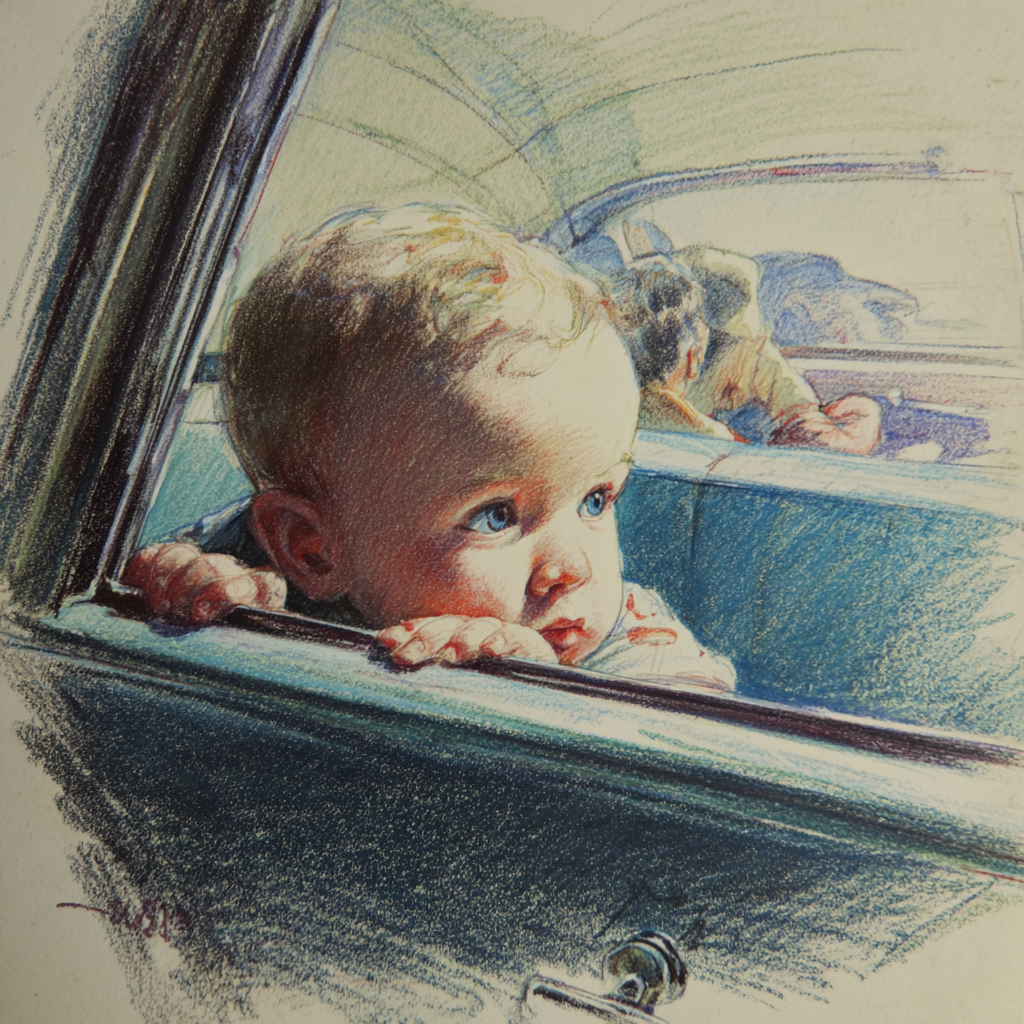
Let's take the case of an infant on his way to be baptized several days after birth. There's a car accident, and the infant is killed. The baptism is missed, of course, and the family and friends gathered in expectation are left with sadness and loss. Instead of welcoming a new human into the spiritual family, their thoughts are directed towards death, the seeming arbitrariness of providence, and the need to begin funeral arrangements for one who only breathed air on his own for a few days.
Under the traditional teaching – which is roughly over a thousand years old – the infant would not be admitted into the presence of God because it would still have Adam's sin: even while being too young psychologically to have ever committed an actual sin. Think of the sin of Adam as being the default, inherited condition of all humans who are born. By itself, this is sufficient cause to keep one from paradise, for nothing unclean can enter into the presence of God. Only God himself can make clean what has become defiled by human action, since humans are too flawed to ever achieve anything like godhood on their own steam.
For this reason, in the traditional creed, it is recorded that Christ descends into hell after his death in order to free the souls of the just men who, while having attained to great natural virtue during their earthly lives, were still under Adam's curse. The descent into hell mentioned in the Apostles' Creed does not state this explicitly, but that is always how it has been understood: he descended into hell (to free the righteous) and, on the third day, rose from the dead.
This trope of descent into hell to complete a mission on behalf of the dead (or the living) would've been very familiar in the Hellenistic world of the first century CE, having been widely disseminated through myths and stories dating back centuries. The hero who passes from life into the kingdom of death is a motif of the classical world.
St. Augustine advanced the view that infants are deprived of entry into heaven if unbaptized, but their fate is bearable – they spend eternity unfulfilled spiritually, but they are not actively tortured by demons, burning lava pits, etc., as are the active sinners, baptized or not. When one recalls that there have been over 100 billion (yes, billion) homo sapiens who have ever been born, hell is indeed a very busy and heavily populated place.
Augustine's original view was further developed into the concept of limbo in the medieval period. Think of limbo as a hot patch for the Christian operating system, an attempt to address an egregious character flaw in Yahweh (more on this later). However, limbo always remained a theologoumenon – an educated, authoritative opinion lacking de fidei status. Meaning, it was a mental construct for navigating one of those morally dubious problems caused by monotheism, not a point of faith or belief. No one could be burned at the stake for rejecting the existence of limbo.
Limbo was the uppermost level of hell, where life was pleasant, and no one suffered from deprivation. However, the humans here would never, ever see God or be welcomed into the company of saints and angels. Thus, the highest end of human life – beatific vision – would be forever denied to them on account of their death before baptism. Christianity has no explicit theory of karma, only a notion of God's absolute sovereignty. God himself cannot be held to any standard of justice or mercy since he transcends these, which are imperfect reflections of his nature. Thus, the child who dies three days after birth is an immortal being going straight to an immortal destiny, a blank slate, so to speak, whose fate has been ordered by the divine will. No previous life of choices, good or bad, determined his fate, just the overarching sovereign will of God. His ways are inscrutable.
For most Westerners, this makes total sense, whether they are believers or not. Materialists will say, yeah, a human is an animal and animals die young sometimes. Christians will say the same, but posit an unending post-mortem career. In both cases, there is a kind of fatalism. The latter is the fatalism of Yahweh’s election or non-election for a particular soul.
Limbo was never really satisfactory to most people who carefully thought about the issue. How could a loving, compassionate God consign an unbaptized child to the uppermost level of hell? Yes, it has tennis courts and all-you-can-eat Chesapeake blue crab, but there is also endless suffering. What suffering do you ask? If you are condemned to a nice resort for all eternity, can you really say you are suffering?
Augustine answers: Our hearts do not rest, O Lord, until they rest in thee!
There is no rest for the wicked, and even under the rubric of limbo, the Club Med of hell, the unbaptized infant is still damned to suffer for all eternity. While the average Westerner might find the idea of the endless resort to be a comforting thought for himself personally, recall that it is still, by Christian standards, a form of suffering. It is, by non-Christian standards, also quite horrid, if one can imagine an eternal Groundhog Day of doing the same things over and over, never getting any final satisfaction from any of it. Separation from God is still a kind of death, and the absence of demons sticking you with pitchforks for all eternity only means that there are degrees of unending torment. Christ is emphatic that there is a second death to be meted out for the unjust; limbo is a death of sorts. No one can be justified who has not passed through the portal of baptism.
So limbo was there as a theological patch, but it was not a good one. Eventually, the Catholic Church formally abolished limbo as a viable theologoumenon in the early 21st century. Here, doctrine was not altered or abolished; rather, an educated, albeit authoritative, opinion was removed because it caused more problems than it solved. Limbo could not resolve the problem of God's justice in contrast to his mercy. Limbo was a world of pleasant sensuality in which sex was not possible since Jesus said that in the hereafter, marriage is not an option (Mt 22:30). Christians have typically understood this to mean that sex is for earthly life and is available in neither heaven nor hell.
Again, let us be clear in understanding that limbo is eternal hell, endless suffering.
Patch 2.0 for Christian OS goes like this: We don't really know what happens to the unbaptized infants, but we can hope for God's mercy. Therefore, leave it alone and don't speculate on the topic. As it is problematic, we ended up with more problems from Patch 1.0, etc. God is not constrained by his own sacraments, so the lack of baptism does not mean he cannot give free admission to paradise to dead babies. Delving too deeply into this could, however, lead to indifferentism or a debasement of the unique, salvific path afforded by Christianity.
But there's a bigger problem, one related to PR. For you see, there is much agitation over the thought of Yahweh consigning children to hell – in the millions – through no personal fault of their own.
Again, recall that billions of humans have lived, however briefly; billions of deaths would have occurred among children from, say, 120,000 BCE to now. (I use 120,000 since this is a commonly accepted date for the appearance of homo sapiens.) When we consider the number of children who would've died in stillbirth, famine, war, exposure; or the number killed by fires, wild animals, accidental falls, human sacrifice, baked in the oven, etc., we see that the question of unbaptized infants affects a vast number of souls, ones who never would've had a baptism available in virtue of being born in the wrong time and place.
It undermines the whole Christian undertaking to say that all humans presumably go to heaven, save maybe Judas and Hitler. For if all go to heaven, then the urgency of moral action loses some steam since the general condition of humans is to follow evil impulses. "The heart of man inclineth towards evils from its youth." This negative view of the human condition is shared in the East and West, as well as by Islam, which sees three-quarters of hell's denizens being of the female persuasion.
Avery Cardinal Dulles, in a famous essay, "The Population of Hell," observes that in surveying Christian literature, the consensus of theologians is that most humans end up eternally damned. If they do so, it is because their founder, Jesus Christ, laid it all out.
“Wide is the way, narrow the path... many (not all!) are called, few are chosen...”
In the last quote, the implication is that not all are even called, never mind chosen. Some do not even get a phone call; they just go to hell. For democratic Western man, this seems especially unfair, since at the very least, everyone should have the choice presented as to where to spend eternity. To not be given the option of voting about the most intimate matter – your personal fate in the afterlife – because of divine caprice is, of course, an outrage. We believe steadfastly in personal moral agency and the power to improve ethically, spiritually and otherwise.
This is to say that Christianity's view of the human race is largely negative. The massa damnata – the writhing mound of bodies caught in various states of sensuality – will find itself in an everlasting fire, prepared before the foundations of the world for the devil and his angels.
With this in mind, what does it matter then if unbaptized babies end up in hell? You, as a human under the Christian view, are already born into a reprobate condition, and your salvation is unlikely according to Jesus.
But isn't hell a matter of choice, an exercise of free will? If billions of people choose hell, then it's on them. This is where it gets hard for most Christians, whatever their lineage, because most operate under the assumption that they are moral agents who can choose or reject Christ.
There is, strictly speaking, no such thing as free will in Christianity. There is a human will impaired by sin that, in virtue of this original wound, is incapable of ever choosing God freely by its own power. To claim that one can choose God as a matter of free volition, unaided by any external force like divine grace, constitutes an early heresy known as Pelagianism. Most Christians I've found are operating as Pelagians, although they likely know nothing of it.
This doctrine leads people to believe that the infants who die are not able to ever make the choice, so there's an unfairness in their damnation. They do not think in terms of man's incapacity, no matter his state, to ever freely choose God in the absence of grace. To them, the thought of a young life ended only days after birth, followed up by a hellish sentencing, is too much. Limbo, when it was still in play, was a hellish destination since everlasting separation from God is counted as an eternal punishment.
This post is just a sketch of some of the problems posed by monotheism. While I've focused on Christianity here, it's the case that all of the Yahwist schools have the same category of problem when accounting for the death of babies before the ability to even reason about moral actions. In Islam, there is, according to my AI prompts, a decidedly optimistic, humane view of the deceased, in that they are assumed to go to heaven since they've not reached the age of moral accountability.
Seems much better than Christianity, but look closer, and the question is obvious: why not turn a blind eye when children are killed, abandoned, or neglected? All of the children murdered by Israelis in Gaza, are they not beneficiaries of the greatest gift? If you won $2 billion in a lottery, it would be nothing when compared to the gift of being killed as a child by starvation or bombing, since this leads immediately to heaven. Heaven is eternal, we are told, and what does it even mean to compare microseconds of a miserable human life to the eternal beatitude of the blessed in heaven?
For a more modern take, why not encourage women to abort their children, or at least show indifference to the growth and availability of the procedure? Since women make up three-quarters of the damned in hell according to Islamic opinion, they can at least contribute something positive by killing their kids. In any society, there will always be abortionists and women who want to abort, so why stop them? Every aborted child is a new soul in paradise — better to take a metal forceps to the noggin and have one's brain sucked out than to live a life where you might fall into sin and end up in hell.
These are the kind of thought processes that take shape when dealing with the problems caused by monotheism. Most believers are happy, however, to say, "leave it up to God; he's smart and will get it all sorted," etc.