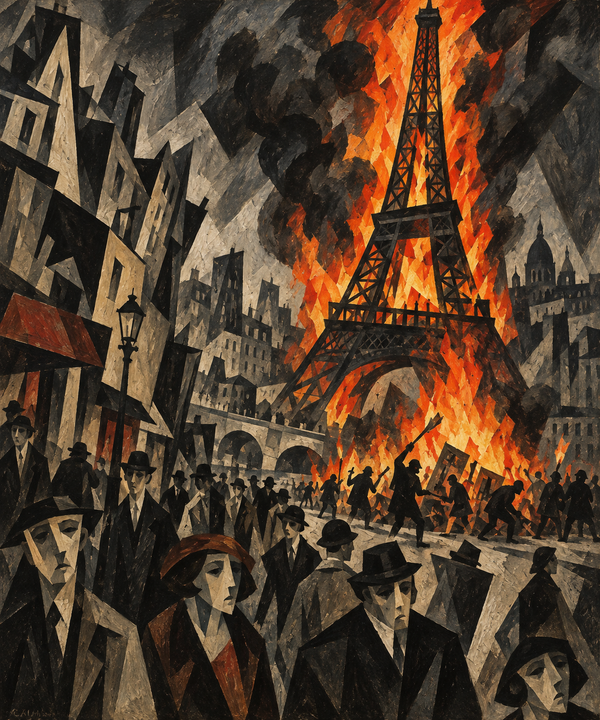
System of a Downer


Charles Upton, The System of the Anti-Christ
I've been reading Charles Upton's book, The System of Anti-Christ, since we here at the Tangle are all about the arrival of the Man of Perdition.
I have an interest in the Anti-Christ because, while I no longer identify as a Christian – when I read presentations of monotheism now, I find them weird, alien – you always carry cultural baggage around with you. One of the keen interests of evangelicals in the 1980s was the End Times, how they would unfold, how to prepare for them, what to wear, etc.
Short version: Get right with Jesus and bring your friends and family with you.
Today, the world has all the signs, portents, and promises of a calamity requiring a global solution. Humanity has fallen so far into nihilism – the old spiritual paths seem closed off, misery is mounting, wars and rumors of war are spreading, corruption sits openly in high places – that we feel at the end of the road. There is for many, a sense of despondency and dread about the future, made worse by the coming of AI. Smart devices dribble out endless streams of depressing information for our viewing pleasure, much of it now manufactured in the bowels of generative models. The always-on generations sit in constant observation of the unwholesome.
If I were an evil potentate, I would make sure everyone had a smartphone and social media. Nothing paralyzes and demoralizes quite like these twin devils.
Technology was supposed to make life better materially, even the playing field, and connect people into new communities founded on shared values and interests. Instead, we got crippling mental illness, anti-social behaviors, and a complete breakdown in anything like a public square.
While I had an evangelical framework with which to interpret these latter days, their wonders and horrors, today's Millennial or Zoomer doesn't. By the time they arrived, the fervor of evangelical Christianity had faded; smart devices meant distraction and absorption into consumer-driven, personalized realities. Grand meta-narratives were to be found, but these collapsed under the weight of conspiracy theories about the Rothschilds, the Rockefellers, and the de-population/alien agendas. I feel OG now.
These "little grand" interpretative frameworks were more sensational, less devotional, less focused on the need for repentance, contrition, and the firm resolution to go, and sin no more. They titillated, left us with a pleasant anxiety about the future, but like all things, lacked any staying power, and their value, if any, was of lesser quality than the evangelicalism I experienced as a child of the 80s.
In alternative media, there are appeals to preserving freedom and our way of life, not anything solid about recognizing transcendent truths which defy the materialistic spirit of the age. The conspiracy bro offers a generic appeal to an older vision of America that is dead, having never existed. It has been replaced by global capitalism, where men have no place, no families, no community, no traditions, nothing salutary to bind them in brotherhood.
Today, Alex Jones, former dean of the school of conspiracy theory, is a broken man apologizing for the president, who is in turn deeply implicated in the Epstein saga. Epstein was everything Jones had warned us about, but when his perfidy was more fully revealed, the dean was the first to bow down, cover it up, and make excuses for Epstein's inner circle of confidants and co-conspirators, since they included Trump. Why? Because Jones needs power and access. As St. Thomas More said to young Roper at the latter's betrayal, "But for Wales?"
But for TACO?
The descriptions of Anti-Christ are widespread throughout the world religions, including Tibetan Buddhism. Upton is himself a Traditionalist in the mold of Schuon, Guénon, and Coomaraswamy. I read a little of all of them decades ago while in college and found them a bit baffling. I still find them the same, but they hold value in helping us to make sense of the current thing. By comparing Upton's Tradition with the Anti-Tradition, we get a feel for what is happening now even if we don't fall squarely into either camp.
What do I mean when I say, "baffling"? Only that the psychology of the apocalypse is already here, and it is the product of the various religious traditions which sprang from Abraham. In turn, the Yahwist schools have earlier influences going back to Persia, to Zoroaster and the fire worshipers, who devised the same basic outline for an End of Days scenario we enjoy now. They too had a prophet who emerges from hibernation to rally the faithful before the last battle. Upton excavates these older influences, but sees them as a profound truth, not a cache of beliefs and practices shaped by evolutionary biology and human culture. If it were me, I would pick Merlin since he too is said to be in stasis, waiting to emerge from a long-forgotten cave to serve at the side of King Arthur for one last go.
Near as I can tell, the Traditionalists see a Single Unified Truth refracted in the world as different authentic religions like Christianity, Islam, and Buddhism. The world is a vast tumble of objects, things bobbing in a soup of time and motion. While there is no one single pristine religion which unites all men, the Truth can and does present itself, just in different garbs, because of human weakness and the nature of our cosmos. Only God can know himself completely, perfectly.
Who is like unto God but God?
Limitations notwithstanding, physical reality still attests to a single Grand Narrative written by a single Grand Narrator. His handiwork is seen everywhere, and the language of metaphor should not be used as a wedge to divide the great traditions, but rather as a tool for digging out the unifying truth. They can each co-exist together while giving true testimony to the Godhead. Neither should they be conflated, an ever-present danger for every student of religion, no matter their stripe. This is the Traditionalists' warning.
Upton is a Sufi Muslim who can quote the New and Old Testaments, the gitas, the sutras, and so on. Traditionalists are, as they say, firmly set on a chosen path, but able to see out across the vistas to find the diamonds glittering in different fields and hollows below.
The Transcendental Unity of Religion and its exponent, The Traditionalist School, stand above it all, but its own internal logic means its members must commit themselves to one of the six revealed paths. They are not looking down long noses at the unwashed mobs, the pure ones spiritually attuned to the truth – the hidden wisdom – set before us in the different religions. Rather, they have a vocation to keep all faiths separate but equal. Guenon still prayed five times a day towards Mecca and kept the fasts.
Each of us must find a home in which to practice an established tradition, but this doesn't prevent a few wise birds from seeing the greater whole, at least in glimpses. Like Guénon, Upton has chosen the Hindu-influenced Sufi School of Islam. This lineage has had a mixed reception from the Ummah, being seen perhaps as tainted by outside influences, its practitioners not entirely faithful to the Prophet's final dispensation. Sufism bears an exoteric and esoteric doctrine along with initiatory rituals, so it appeals to some Traditionalists looking for the full meal deal.
There are imposters – counter-agents of Traditionalism – to be sure, and these charlatans will ape its language, borrow its analytic and grammar, in order to deceive, if possible, even the elect. These are the minions of Anti-Christ, the deceiver, the architect of a New World Order, which promises to be a new Golden Yuga, but is in fact a counterfeit who leads many into hell. The NWO inverts every value, turns it on its head, yet its daring conceit is so soothing, so believable, so desirable that it draws all things unto itself.
Why?
Primarily because it feeds the ego, the spirit of the age, while veiled in the bright glitter of real transcendent spirituality. Whereas Jesus took pity on the multitude when he saw their physical hunger and gave them food both spiritual and physical, the Anti-Christ just gives everyone food and a false sense of peace and unity based on pablum. Thanks to modern technology, pablum, tripe, and maliciousness can be shared all over the world with a handheld supercomputer. Jesus fed the stomachs because he needed to reach hearts. The growling stomach is a barrier to the heart. As Upton points out, the world is materia and forma; man is body and soul. The physician who would heal both must consider the two in tandem.
The Anti-Christ furnishes the miserable masses with goyslop and New Age tripe, fake guru miracles like those wrought by John of God. The average person is easily caught in the net of deception if he's already strayed from (or never had, as most moderns) an authentic spiritual path under the shelter of Tradition. When the Anti-Christ comes, many Muslims, Christians, and Jews will fall easily for his false prophet and herald, who comes in bitter mockery of St. John the Forerunner. Instead of the six gems divinely-ordained, the Anti-Christ combines fake baubles into a single global religion, to spite the Transcendent Unity of Religion.
One might wonder whether this Tradition is similar in kind to the one spoken of by Freemasons. From the outside, one might feel that these comparative religion exercises mimic the appeal the Lodge makes to a Great Architect of the Universe, who reveals himself in different ways to different men, yet remains the same today, yesterday, and tomorrow. While the brotherhood doesn't make many theological claims about the Higher Power and his relationship to the cosmos, the implicit theme of the ritual is that these are meta, antecedent in time and ontology to the ones found at your local Catholic parish or mosque. They are initiatory in character, bringing the member into the fold of an esoteric tradition that stretches into the distant past, when the Temple of Solomon was still being planned. I am sure there are Masons who link their unique system to the pyramid builders of ancient Egypt. Masonry makes you moral via alchemical transmutation experienced in rite, ritual, and dogma.
The theory of a primordial religion which sits, in some sense, as a judge over revelation is explicitly condemned by the old Catholic Church. The only true revelation was given by God himself in the form of Jesus Christ, and it was neither esoteric nor lacking anything pertaining to salvation. Its Triune God reveals the deepest mystery about divinity to the human race and thus possesses a more complete picture than either Judaism or Islam. A Muslim cannot claim to have a greater-than-or-equal faith since it misses a very profound feature of deity: The Father and the Son, the procession of the Holy Spirit. The Traditionalist can speak broadly and with eloquence about the grandeur of divinity, but the devil is in the details. These matter. A lot.
Traditionalists have looked in every crevice and crack of the public, exoteric faiths for signs of esoteric doctrines, and they have, of course, found them to some degree. But Jesus, like the Buddha before him, reminded his followers that he taught publicly, openly, and with no hand held behind his back clutching a scroll of secret doctrine.
Jesus answered him, 'I spoke openly to the world. I always taught in synagogues and in the temple, where the Jews always meet, and in secret I have said nothing.'
The Buddha reminded his followers that he taught with an open hand, never holding back anything necessary to end suffering. In another story, he grabs a handful of leaves and says, "These are my teachings. The forest is full of trees and their leaves, but the leaves held here are all that is needed for niroda." In other words, don't get lost in the trees looking for enticing leaves from exotic trees. You will only find serpents and brambles.
The System provides some comparative examinations of the Anti-Christ, as understood in Christianity, Judaism, Islam, Native American religions and Buddhism. Comparative religion has a place in Tradition, but as the springboard for transcendental development and initiation. The Buddhism in this case is Tibetan-flavored, so it's basically Hindu in its outlook on matters apocalyptic. Theravada gets only a brief passing mention in the 600 or so pages since it is not well-suited to a monotheistic-rooted meta-narrative. If you are writing page after page in defense of the immanence and transcendence of the Godhead, Theravada and early Buddhism will not furnish much material to support your efforts.
Upton bristles at the thesis of modern comparative religious studies. This secular field seeks to deconstruct truth, reducing it to purely human inspirational sources. Traditionalism seeks to find the concordance while respecting the deltas, honoring a God who is both transcendent and immanent at once. These distinct paths are boundaries that God himself intended since he cannot be captured in any single system of ritual, spirituality, or practice. Pope Francis, who signed a common declaration with a Muslim scholar on the nature of religious diversity, agreed in principle with this claim despite it being a heresy. God intended/willed the plurality of religions we see before us. Professional "traditional" Catholics have busied themselves with fine-tuning what is meant by this willing of their deity, to keep Francis from being branded as a heretic. Francis may have been a proponent of Traditionalism!
My skepticism of all things monotheistic caused me to see in Upton's examination of various Anti-Christ schemas a human cause for their similarities. For the Yahwist schools, this is pretty simple since all the religions share a repertoire of language, symbols, and characters based on a common text which has seen wide dissemination. Thus, Enoch and Elijah have their roles in heralding the end of the age for both Christians and Jews; Jesus slays the Anti-Christ in the Islamic motif. Where cultural contact cannot explain, the fundamentals of human psychology will do.
The Hindu Kalki, like the figure in the Apocalypse of St. John, rides a white horse, bears a sword, and slays the evil doers on the field of battle. For the Tibetan rendition, the king of Shambala marches forth (on horse again) against the forces of darkness, who have overwhelmed and buried every last good thing until there is nothing left. In the examples given, the end of the age is brought about by the will of God, who sets about creating a new heaven and new earth, after the last traces of Satan are removed from the high places and his armies no more. The old cycle ends, and another one begins. Will there be another Fall to start the next decline?
Traditionalist works select what they need to make their point; the average layman is left with a Reader's Digest version made to fit the metaphysic of the Transcendent Unity of Religion. Upton has a late chapter titled something like, The Transcendent Unity of Religion vs. The System of Anti-Christ. He, of course, means the Primordial Religion perceived prismatically in the righteousness of all major religious bodies. The New Age movement is the antithesis of Tradition that aims to compress, distort, and unify all religions, against the intentions of God. The theme of the Anti-Christ system is the Monad – everything becomes one. One currency, one system of laws, one leader, one indistinct gender, one religion, one world. The diversity that God intended in races, nations, languages, and creeds is cast aside for a Single Transcendental Anti-Religion. It is Babylon revived. The particular and the parochial, which give the human heart an anchor, are replaced by abstraction, tyranny, dilution, uniformity. This is Guénon's "reign of quantity."
I side with the humanist, comparative religion camp. As with all things monotheistic, Ockham's Razor does the heavy work of sifting out truth in one quick stroke. Or two. I can and do agree with Upton, however, that the System he describes is hellish and can only end in much misery for the whole planet.
Humans share their languages, culture, and ideas via oral and written transmission. While once tribal, we were still in communication with one another and, naturally, our concepts moved around and, like seeds in the wind, took root in different places, grew up in different soil, and changed in hue or shape. Still, a rose is a rose, whether red or white; you can't hide the source. Whether you claim the source is the divine, or whether you see the human, all too human, is a matter of choice. The presence of shared theological ideas means either divine revelation is real or human psychology functions on the same level across time and culture and thus is itself the transcendent.
Within a single tradition, doctrine develops: In the Torah, the volcanic Mt. Sinai is replaced in later Talmudic commentaries by a mountain that hovers over the Israelites. Yahweh threatens them with utter destruction if they do not submit to his proposed covenant. Islam riffs on the same rabbinic commentary when it appeals to the levitating Sinai: God is no longer inviting Israel into a special relationship, but is threatening them with extinction, just like the pharaoh of Egypt, if they do not agree to follow his law. Placed in the sandals of the Israelite standing at the base of Mt. Sinai, it's a case of, "Out of the (flesh) pot, into the volcano." Damned if you do, damned if you don't. Follow the law of God or the law of man (Pharaoh), but reject either, and you die. Jesus would say, "Do not fear the man who can kill the body; fear the one who can kill the spirit."
Harried, killed, and hunted by the most powerful man in the world, they fled into the desert only to be threatened with total annihilation at the hands of an angry god if they didn't sign a contract.
A contract signed under duress by either party is no contract, as a rabbinic gloss makes clear. Thus, Judaism sees the covenant at Mt. Sinai as invalid. It was in post-exile that the Jews freely chose to accept the original offer, this time, with no burning mountain hanging over their heads. Thus, they became the Chosen People of Yahweh only later, several generations after the deaths of Moses and Aaron. "Yeah, we'll take this here contract home and think about it for a few hundred years... We'll be in touch!"
These types of doctrinal developments are purely human in origin and fulfill a psychological need. Why did Yahweh manifest as an active volcano at Mt. Sinai while today, he is quiet and hidden? This was the question that set the rabbis to editing their theology and literature. Human need, in other words, is the mother of invention. "Our fathers saw and heard God – the I Am Who Am – in a burning bush, in the belching of fire and smoke from an Arabian mountain, but we see nothing, hear nothing. What has happened? Has Yahweh ghosted us? So asked the post-exilic Jews.
The problem with creative, fantastical stories is that people start wondering about them, their veracity in light of their own later conditions. The most pointed critics of the miraculous are sometimes themselves members of a religion based on it.
As religion matures, it becomes more spiritual and less focused on physical signs and wonders. The same development is found in Christianity, where the early centuries of martyrs and saints, who raised the dead and performed other miracles, gave way to doctors of the inner world, like St. Theresa of Avila. The real miracle of faith is not to be found in the burning bush that speaks, but in the quelling of the passions, of the heart that finds earthly rest in the bosom of the divine, all in hopeful longing of a future world, where justice, peace and love reign, world without end. Amen.
The locus of human need is also found in the story of Shambala. The text which provides this story is the Kalachakra Tantra, and Upton cites sources showing that the righteous in this setting are promised eternal life if they but remain faithful to the dhamma and do battle against the approaching baleful army of evil. As someone of the Theravada lineage in thinking and practice, this is not Buddhism. All things, without exception, this side of Nibbana are impermanent, unsatisfactory, not me, not myself. Immortality is not in the cards, even for the beings dwelling in the Brahma realms, since they too will be brought low to a hell realm once their tenure ends.
This is the problem with Traditionalism, that it applies a common schema to six "authentic" traditions while ignoring that one of them explicitly repudiates the existence of a creator god and personal immortality. Nibanna is Ultimate Reality, but it is not a creator god. The one who taught us about it said so – emphatically. Later Westerners under the influence of Hinduism wanted to change the teaching that was subtle, hard to see – make it work for them instead of the other way around.
Tibetanists will of course claim that the immortality spoken of is the deathless, Nibbana. Then they will go on to talk about various buddhas – how you and me all have a buddha nature. And there are gods and goddesses, oh, and the Dalai Lama is a reincarnated god brought back by the bodhisattva vow, etc. This is all I-making, my-making. It is ego in the subtlest form.
Many years ago, I enjoyed listening to Dr. Wayne Dyer's talks. I still do. His Atman was pleasant, and the whole process of hearing him speak lifted something heavy. But I don't believe there is an Atman/Brahma, and Dyer, like many in the New Age movement, got sucked into the John of God booster camp.
Traditionalists always respond with an appeal to the esoteric: Schuon said the Buddha had to teach a grueling via negativa as an unorthodox way to get his listeners to Atman. See, the Buddha has Atman just like everyone else, but in his exoteric teaching, he had to excoriate it because the doctrine, in the mouths of proto-Hindus, had become corrupted. So he restores Atman/Brahma by apophatic exotericism, but look underneath it all: Nibbana = Brahma. How do we know? Because that's what makes sense to someone who has ego delusion and wants Buddhism, a square, to fit through a round hole he calls "The Primordial Religion." This is how we make the sausage!
This claim by Schuon is reflected in other writers who don't bother with the label "esoteric" at all. I'm thinking here of Stephen Batchelor, whose Buddhism Without Beliefs posits that the Buddha, deep down, didn't really believe in rebirth, or that it was immaterial to his mission to ease suffering. The Buddha of the Pali texts says there is heaven, hell, kamma (volition), rebirth... Heaven or hell is moot if there is no rebirth. But Batchelor, like Schuon, has been able to suss out the secret, yet admits that his motivation is his own materialism.
Heaven or hell are states of the here and now, metaphors for our condition in the present moment. Kamma is a psychological state, not a natural force that continues on after the last breath. Like the Anti-Christ of Upton's meditation, Batchelor lays low the very things in the ancient ways that make them shimmer with transcendent truth. If everything can be reduced to materialism, then it will be. If everything can be reduced to God, then it will be. The Middle Way rejects both of these as extremes, as Wrong View.
"Rebirth is impossible because science says so, ergo, I will cleanse the buddhadhamma of cultural accretions that don't match Westernism, keep the bits that I decide are still relevant for today's educated audience. See, I have the Rosetta Stone that unlocks the meaning, keeps the Buddha fresh and relevant to today's busy, always connected people!"
By explaining that the Buddha just went along with the spirit of the time, avoiding conflicts and debates over rebirth when it was the regnant view of life/death, focusing instead on the cause of suffering, the Lord apparently succeeded in his mission.
One cannot read the Pali Canon – and recall that Batchelor went the Tibetan route when he was trying to ordain – and not come across rebirth as a brute fact of nature. It's everywhere in the text. I wonder if Batchelor would've gone a very different way entirely if he had just read those instead of seeking out lamas, secret lineages and hidden masters. His own form of esotericism was probably shaped by his association with Tibetanism as a young man. When he gave up on Tibetanism, he didn't leave behind its hermeneutic of hiddenness. He is a public secular lama, so to speak, who has an esoteric way of unpacking the real, authentic Buddhism.
Not satisfied to reduce rebirth to a useful but culturally narrow teaching tool, Batchelor in later years decided the Four Noble Truths needed an update as well. The spirit of esotericism shares something of the scientism it claims to oppose. Batchelor and Upton's Tradition have the same psychology even if their ends and beliefs differ. Both seek to attenuate different truths to the present circumstances.
Esotericism is unfalsifiable and contrary to the spirit of the teachings of both Jesus and Buddha, probably for similar reasons.
I cannot prove to anyone that the Buddha did not have a secret doctrine of tantric sex with hookers that made the trip to Nibbana faster and better, and that he passed it down to lesser-known monks in his sangha. I don't have to, and prima facie, it conflicts with everything we have from him in the Pali Nikayas. Reasonable men and women simply do not take the bait. One may claim whatever suits him about a religious teacher under the rubric of a secret lineage with its own initiation and special gurus. But Buddhism is not about gurus.
The Kalachakra is a relatively late text composed in India in the 10th or 11th century, a time in which Indian Buddhism was dying out rapidly, encroached upon by Islam and Hinduism. It took to itself the language of Hinduism, its gods and their promises of immortal life. The Buddha critiqued the proto-Hindus of his time, rejecting their rites, rituals, monotheism and so on, but his spiritual descendants, faced with obliteration, came under the intellectual dominance of the majorities in whose midst they found themselves.
Syncretism did not, however, save them; it buried them under the weight of the very doctrines their master had rejected, leaving little trace of the Buddha in India. Here, in the Kalachakra, we have the natural source of the Primordial Religion's take on the apocalypse. It isn't delivered by God. It's humans inspired by the God who foretells great future events.
Buddhism is not permanent; it will die out, just as it did in India, and unlike the other authentic traditions Upton talks about, there is no final trumpet blast, no battle of angels and demons to usher in a new age of immortality. Cycles do end, but in the Pali Canon, there isn't much dwelling upon how this happens, or what it looks like for those who undergo its rigors. The universe expands, it contracts, and this has been going on for a very long time, with civilizations rising and falling. That's about how far it goes. Oh, and men become bestial, thoughtless, violent, immune to the dhamma.
"I preach suffering and the end of suffering."
This is my touchstone for all things buddhadhamma. If the bearer of a new gospel preaches an unknown doctrine, I measure it against this, finding its relative proximity to less "inspired" sources.
Telling me about the new heaven and new earth, well... it's all old hat at this point. As I've written about before, Lucifer was arrayed like no other being in the heavens; he was the favorite of Yahweh. Still, he had dukkha.
"Oh, this does not satisfy me; this could be better," etc. We are all Lucifer when we have money, health, safety, comfort, friendship, acceptance. If only I had this one more thing... then all would be well! What I have is plenty, except for this small detail! The Anti-Christ promises plenty for everyone, an end to the grind, an earthly rest from labor and conflict. The implication is that Lucifer wants to give everyone physical contentment because Yahweh won't. He's tightfisted, like a god of metalworkers would be. Even in late-stage capitalism, Yahweh bears traces of his origins in ancient Canaan and northern Arabia.
The Christians are right that there is volition, but they skip over why it can turn this way, then that, even when the one willing is God's most favored. They name it the "mystery of iniquity," whereas the Buddha and his disciples find impermanence in all created things.
The dhamma is not an abstract metaphysical system about substance, accidents, essence, form, spirit, soul, beauty, etc. It certainly did not, contra the Tibetans, preach a future world of immortality for individuals. The wheel of samsara turns and you've done it all a billion times before. The Buddha stands with the Preacher of the Hebrew Testament in this respect: There is nothing new under the sun. He reminded his followers that in his life, he had partaken of the subtlest curries, eaten from the finest tables, worn the finest linens. They weren't enough to purify the heart.
The Traditionalists must know that the yugas are a never-ending wheel of motion, and that any hopes for a final, eternal Golden Age are not present, either in Hinduism or Buddhism. The former they draw heavily from in their own thought while finding variants in the religions of the Lakota and other indigenous Americans. The ubiquity of the metal themes in describing human civilization means, if anything, that there must be rebirth, because as ages crumble, they destroy angels and men alike. When the next Golden Age gives way to the baser Silver Age, there will be casualties. Where do those poor souls go? Does Upton believe in reincarnation? If he is to remain faithful to the exoteric manifestation of Islam as all Traditionalists would agree is required, then he would have to answer, "No!" But if he answers no, how does he reconcile this with the Primordial Religion's cyclic theory of the cosmos? Reincarnation goes hand-in-hand with the yugas. There is no jumping-off point in the cycles outside of Nibbana.
For those interested in how the age will end or what the divine meaning is behind it, or what awaits humanity on the other side, Buddhism is not the religion to go to since it has nothing to say about it other than, "This too shall pass."
I've read a claim that, perhaps owing to the "dualistic" tendencies of Traditionalism, its proponents believed the followers of the exoteric could gain heaven for adherence to external doctrine, law, and ritual, but that the more esoteric devotees were looking for something beyond heaven, like union with Brahman via moksha.
If the Theravadan points to the Buddha's explicit rejection of the Atman/Brahman, they simply go back to the unfalsifiable claim of a secret doctrine, or an esoteric meaning that had to be discovered through arduous spiritual effort. These mini-revelations become another turning of the wheel of dharma. The Pali Canon is replaced by the Lotus Sutra – is in fact "perfected" – by later revelations of deluded monks.
With Traditionalism, Upton undertakes what he himself admits as a parlous tight-rope walk. Remaining faithful to his own tradition (lowercase t) while remaining mindful of its part in a large spider web (his image) is no easy thing. As I've indicated, there are certain absolutes that are irreconcilable in a godhead who sets out different paths, and Upton, of course, recognizes this. I see earthly origins in the theocentric religions, but this doesn't mean that they are empty of great spiritual value and insight.
Maha Boowa spoke like an aryan: There is Right View, and only we (the Buddhists) have it. Dig deep into early Buddhist texts, and you will see that it stands alone in a sea of religions focused on gods/goddesses/divinities, their attendant rituals, and an endless proliferation of abstract concepts. "My dhamma is hard to grasp, subtle, not easy to see... yet it is to be experienced here and now for those who try." So said the Lord.
The later chapters of Upton's book are filled with very deep spiritual reflections and associations. His exegesis of Jesus and Caesar's coin – render unto Caesar... – is quite poignant, quite powerful because they draw from different sources. Traditionalists walk a fine line between being deeply immersed in all levels of authentic tradition and getting lost in relativism.
While I have taken the liberty of critiquing some of his points, I wholeheartedly recommend the work for its combination of scholarship, wisdom, and spiritual depth. As a practitioner, I find myself with gratitude for the treasures I find. I thank Charles Upton for writing this book.
May he be well, may he be at ease, may he be light in body and mind!