Human Slop


I've been listening to podcasts for the past couple of days that talk about the end of writing and the end of the world.
AI slop has taken over the publishing industry, flooding the market with low-quality, chatbot-generated self-published literature. Some of the characteristics of machine-produced fiction include elaborate scenes – punctuated by gratuitous em dashes – and long lists of uninspired, aimless, wandering, pointless, useless, low-energy adjectives that needlessly embellish characters and scenes lacking any action and a clear story arc.
These discussions invariably turn to the authenticity of human-generated art, whether visual, audio, or literary. Some argue you can "feel" whether something is human-made because it has an authentic voice. Humans and other sentient beings suffer; machines don't. This brute fact means the former can speak with a voice of experience and insight, whereas the latter can only insincerely relate content it doesn't really experience or understand. We suffering animals know the poseur. Real humans write about dukkha. If there were no dukkha, art and literature would have no reason to exist.
I understand the point, but they leave out that, before the rise of LLMs, there were years when 1.7 million or more titles were published (2018) and disseminated on places like Amazon. Did anyone read most of those to any significant degree? No. We have more writers now than there are readers. By 2010, pleasure and personal enrichment reading had already begun to decline sharply as people moved to social media. Easy, bite-sized nuggets delivered in a steady stream. Social media consumption mimics American non-stop snacking. A tweet is the cognitive version of a cheesy poof. Both lead to bloat and inertia.

Worriers over the demise of literature fixate on human writing as inherently worthy and on whether the publishing industry will even make economic sense in a world where AI can generate individually customized content on demand.
One follow-up complaint is that AI just reassembles existing human-generated content, so it lacks the drive to push the boundaries of the literary craft. This is a moment in time, a transition period, so I wouldn't bank on it remaining true in six or eighteen months. One industrious person recently created a system of agents that produced writing lacking any discernible AI fingerprints. But the death of sci-fi, the novel, and other literary forms was already being hailed well before LLMs. AI isn't killing literature; it's merely highlighted its true state.
Within the past several days, another wave of alarms sounded as a pretraining researcher at Anthropic, Jacob Coxon, resigned over misalignment concerns. There is a ten percent chance (according to Coxon's former colleague, Hubinger) that AI will destroy all human life in the next few years. This fear of a Skynet annihilation comes at a moment when two wars are being fought that are reshaping the entire global order, and not in a good way. A proto-Skynet didn't start these. Skyrocketing food and fuel prices in the Global South are all squarely human in origin.
The first war, Russia vs. Ukraine, is entering its fifth year, and disruptions to refineries have propelled diesel prices to record highs. Winter will be especially cold, dark, and grim as heating costs price the poor and lower-middle classes out of the market. A ZeroHedge article today reaffirms that Europe is prepping its populations for military conflict and hardship, urging civilians to stock up on water and tins.
The U.S.-Iran conflict adds pressure to food and energy markets, on top of the previous conflict just cited. According to a recent Pentagon Inspector General's report, hundreds of U.S. military buildings in the Near East have been damaged or destroyed by Iranian drones and missiles. Iranian-backed Iraqi militias' recent attack shut down the Saudi pipeline running from east to west, and the Strait of Hormuz remains closed to normal shipping traffic. There is a feeling that either World War III has already started or will start soon, as the old order is being torn down and new powers emerge from the shadows. Periods of imperial decline are racked by war and destabilization.
This is the layout: AI has an X percent chance of killing us all, but the human-confected World War III underway is at least authentic and genuinely human, and therefore tolerable because it's relatable. It is therefore to be preferred. Professional writers worry about the loss of human books, slop or not, and the public stresses over a possible Skynet future even as the world is moving on human power toward the End of Days, courtesy of a mushroom cloud or biological weapon.
The rational question: Do we really need all the human-slop literature, and do we want the human-slop governments that are incapable of pursuing peace and justice for all peoples? If we froze AI research and pulled back all LLMs into private labs, would humanity be better off?
As IT professionals, do we need authentically produced human code slop that produces expensive, hard-to-maintain systems filled with security vulnerabilities?
As music fans, do we need to go back to the pre-AI music production systems that created flat, insipid electronic noise beginning in the Aughts?
A few oddballs prefer older albums where imperfections in the instruments and singing could be heard, but the machine-smoothing of 1990s and later production eras eliminated them. Rick Beato's YouTube channel chronicles the death of natural musical talent and good taste. He was complaining about the dumbing down of music long before AI reared its head on Spotify. Most of his shows are master-level mini-courses on what makes a song or artist worth a listen.
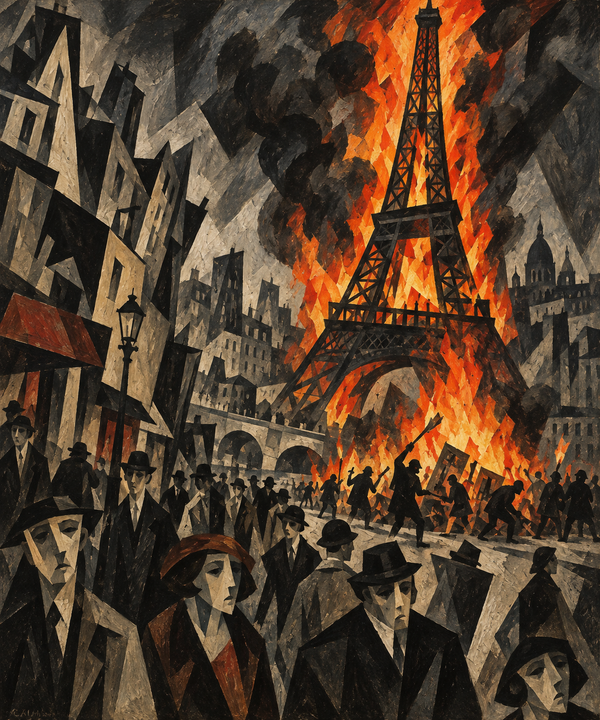
Humans are looking at a possible AI-run future, fretting about worst-case scenarios while their houses are burning down now. A ten percent chance of human extinction by AI is appalling because the agent of demise is non-human. A one-hundred percent chance of destruction caused by human greed and callousness is doable because it's authentic, artisanally crafted. But in this analysis, a ninety-percent chance of a better world of plenty is an unacceptable risk.
An 80-year-old demented American president addressed the U.N. yesterday, threatening to annihilate the 90 million people of Iran for failure to comply with his administration's demands. His cabinet did not invoke the 25th Amendment to have him removed on the grounds that he is unfit to serve.
Human fear of an AI apocalypse is naive, though, because the fear isn't of AI; it's the fear of a tiny clique of humans running AI for their own private profit. AI is probably not going to kill most of us off because it "chooses" to do so. The insidious scenarios involve it acting mechanistically and deterministically, according to logic we don't understand, when the real risk is a ruling class using an AI "mishap" – a lab leak, an accidentally launched ICBM – as cover for dealing with the complexity of unraveling techno-societies. Oligarchs are building bunkers and protected compounds in places like New Zealand and Argentina.
To quote Jedi Master Yoda:
"All his life has he looked away... to the future, to the horizon. Never his mind on where he was. Hmm? What he was doing. Hmph. Adventure. Heh. Excitement. Heh. A Jedi craves not these things."
We need a pause, not to fret over AI simply, but to reflect on what is happening in the human sphere right now, and what the human weaknesses on display will mean when improved AI capabilities augment them in the future. The Trump administration this week approved a $2.8 billion weapons gift of 40,000 2,000 lb. bombs to Israel, which has waged a genocidal war against the people of Gaza for the last three years.
AI didn't propose or approve this transfer. The men who approved this are not focused on where we are or what we are doing. AI will become, like the 2,000 lbs. bombs, another tool of the powerful.