Dead Internet Theory

I keep seeing think pieces, vlogs, and essays on the death of the Internet.
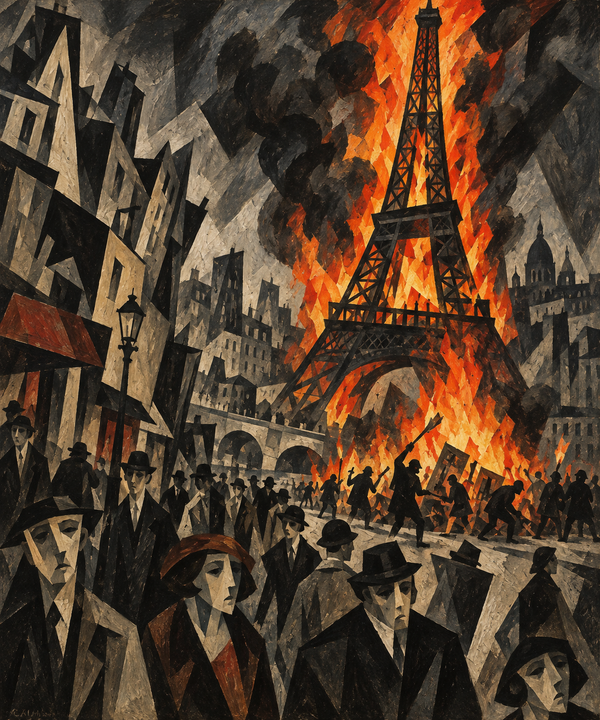
The narrative goes like this: The Internet in the 1990s was a Wild West where humans were the creators of all content, and it was unpredictable, zany, engaging, and adventurous. Then corporations, via social media, began building walled gardens. By 20XX, half of all Internet traffic was bot traffic. Then there follows a future projection: by 20YY, most of all traffic and content will be produced by AI.
There is a general concern that the Internet has collapsed in on itself, much like the death of the universe as described in certain scientific cosmologies, where all the remaining debris sinks into a singularity once all the stars have exhausted their fuel. Maybe a new universe will somehow emerge from it. That's probably not how it works, though.
CompuServ and AOL were the walled gardens of the 1990s, and in those days they had their own browsers you could use to leave their closed communities, chat rooms, and bulletin boards to roam the World Wide Web. Eventually, both companies died as the open Internet became the focus of human interest and the little walled gardens were emptied of their visitors. AOL still exists, but it is nothing like the giant it was back in 1997. As web browsers and dial-up services spread, more content was created, rendering closed, curated spaces moot. People forget that in the 90s, these little areas had moderators and censors, much like what we had later under the reign of the techno lords of Facebook and Google.
I have fond memories of AOL and miss it as I do all things 90s. It was such a positive decade in many ways, filled with fresh possibilities for growth, prosperity, and peace. The Cold War was over, and computing was becoming much more powerful. Games, video, and photo editing software became engaging, much more capable of fueling creativity. I discovered Photoshop sometime around 1998 and got paid to do odd jobs for customers as a graphic designer.
The advent of social media and corporations like Google and Facebook saw the resurrection of the walled garden. Today, X (formerly Twitter) requires an account to browse the messages posted in the public square. Like AOL, you need a membership to see what people are saying. Facebook is the same. No anonymous browsing – you are the price of admission. If you are not being data-harvested, then you are just a freeloader and must remain outside the virtual block party/barbecue. AOL and CompuServe charged like $10 per month, as I recall, to use their little garden clubs, and here, decades later, we are back to their model.
I want to defend AI and its content from the perspective of someone who now sees the Internet as a utility, not as a big world for community building, friendship-finding, or romance. The Internet is actually inimical to these things. Most of us have given up on finding them in cyberspace, and I won't go over the stories of the awfulness of dating sites or of the epidemic of loneliness that has taken hold of generations of moderns. If the Internet were a gateway to real-life connections and community, then the loneliness and isolation that Mark Zuckerberg discussed in a recent interview wouldn't be issues. We would go to meetup.com, find new friends, and spend our weekends and evenings building community or exploring new restaurants and parks. More people would be getting married, more babies would be showing up, and so on.
Well before AI, the web was moving towards a sterile, corporate type of content. Fewer and fewer sites were being maintained by individuals and small groups of like-minded people centered on a common interest, like role-playing games. The reason? Maintaining content takes work, and it must be done over weeks, months, and years. It's also an activity that doesn't pay much, if at all.
YouTube lets creators produce content in exchange for a more stable income, but think about the kind of life you create for yourself. You are on the treadmill of producing new material for an audience that is fickle and easily distracted. Say something naughty, your livelihood ends and your many hours of content creation disappear.
This to say that even paid content creation poses challenges to longevity, variety and quality.
I recently saw a young woman on YouTube announcing that she was quitting her regular job to work on her channel full-time. Her channel was about painting miniatures. Yup. It's a fine hobby, but imagine trying to produce content around it in 5-10 years. Talk about grinding on a topic that long because it pays your bills while dozens, if not hundreds, of others are also making the same content. Maybe you branch out, pick up other skills, and produce new content for that.
Maybe.
It seems like a hard path to follow: the endless curation and creation of new material designed to keep eyes on you. To make matters worse, many of the content creators are just AI voices reading AI-produced scripts. As with all things AI-related, the end goal is to eliminate the highest cost factor in the production of a good or service – the human laborer. Why not YouTube content creators? The Holy Grail, beyond the elimination of labor, is the elimination of yourself as a factor in your own small business. Day traders speak of the elusive automated trading strategy that generates income for them as they do other fun things.
Someone remarked that AI-generated art really expresses the years just prior to the unveiling of art generators like Midjourney. Put another way, the AI art of today is a frozen snapshot of all art as it was in 2018. This is an exaggeration, but there is a kernel of truth. We will not see any new art styles coming, just rehashing, splicing, and gluing together what already exists. Civilization in general feels that way now. Look at a photo of someone from 2010 and whatever they're wearing; you will still find the same being worn today. It used to be the case that one could know the decade a photo was taken in just by the clothes worn. Post-post-modern means post-post-everything.
Recall that around 2003, blogging became a thing. I blogged back then as well, and there were sites like Blogspot that facilitated the creation of written content. All curated, very little of it producing revenue for the writers. And it died.
Not blogging. Blogging didn't die die, but as an activity, it went into decline as social media and the 140-character blurb and high-def images took over the Internet. It is like ham radios, something a few eccentrics still do.
Left out, though, is that people were happy to give up the longer form of blog reading and writing in favor of shorter bits posted on a social media feed because, well, reading requires more mental focus. You can doomscroll through a feed, and your mind can collect tiny bits of info – very little of which is useful – in hopes of finding the nugget, and it can do so drowsily, flitting in and out of attentive focus. I do this with my day trading feeds – it only takes a few good tips to make hundreds or thousands of dollars in the day. The mind has to quickly sift out these few precious hints from the deluge of garbage. I skim material, looking for signs of hidden, deeper potential profit.
AI has served up an uncomfortable truth for some of us – that content can and is produced which is worth reading and informative precisely because much of human activity can be replicated by it. If the point of my feeds is to acquire information – about day trades or new upcoming shows on streams – then the author of such content is immaterial; and if it can be automated so that this stream matches my needs and tastes, then so much the better.
Do you need a human author on the other end in order to benefit from material? What if the material is not about information in the form of how-to, but about something deeper? Would the fact that the author is human make the material better?
For me, no. I do not have a personal relationship with any author I read, and by author, I mean anyone who puts out written content on the Internet or in legacy books. We like to think that humans are unique and bring a special insight to things that a pure machine algorithm cannot, failing to recall that any written material has meaning for us because we provide it, not the author. The author who writes movingly about his struggles is fabricating his material; we choose to what degree we will cooperate with him in his tale, what value or embellishment we will add to make it our own. We all fabricate in the sense that when we recall, we instantly reinterpret.
Truth be told, most human verbal interaction is the exchange of generic signals void of any personalization or awareness. Some of us choose to believe that a human vocalizing an ignorant platitude or using lazy speech filled with nostrums is special. It ain't. Most speech is in fact for the purpose of conveying useful information that gets us from point A to point B. It is even more powerful as a sedative that establishes normalcy and convention even when those are harmful. We will take safety and the known over uncertainty. If that means blending by using the same words and phrases – void of real value – then so be it. Used to be the case that we reserved the meaningful, significant use of language for our intimates or, if we were writers or artists, for certain audiences.
Speech also reshapes, reinvents, sculpts, and even deceives, whether willingly or unconsciously. There is no solid standard of objective truth available to each of us as individuals – and note carefully, I only observe that such a concept is not attainable to most of us simple mortals.
I blogged recently about my return to RPGs via Discord. The likelihood of finding a stable group in meatspace is nil, and the virtual tabletop seemed popular and well developed. I enjoyed the sessions I had, but the Traveller group was getting pretty dry.
One night, we were excitedly talking about a major plan to deal with a major problem, the first point of real interest for me in weeks, since it dealt with intergalactic politics, strategy, treachery, loyalty, etc. The sessions had felt like an Apple TV series, lacking movement, action, and ponderous pretension. It was the first interesting point in several sessions, and I made some offhand, lighthearted comment about another player's character. It wasn't an insult; I was referring to the character's daddy. This PC's character's father was the king of a planet, and by suggesting we talk to your daddy about which side to take in a civil war...
The person in question somehow took this as a personal insult, threw a yellow card, and left the game. The other players and I sat around, stumped, since we didn't understand the issue that led to the sudden cancellation of our session.
A few days later, the GM reached out about daddy and said that I would need to tone it down. I did the reasonable thing and excused myself from the virtual table on the grounds that this level of sensitivity wasn't one I was comfortable with. The same player had only posted an animated GIF of donuts being pumped with cream days earlier, suggesting that one of the players was intimately familiar with this. It was a sexual joke and was taken that way. No one threw a yellow card.
As I thought about the incident, I realized a few things: I knew nothing about the player, his real name, his occupation. I knew his generation because he mentioned it. Another player played an alcoholic doctor and talked about alcohol use in his real life and in the life of his character. Having been very dependent on it myself not so long ago, I know an alcoholic when I meet one. Alcoholics tend to talk about it, make it a part of their conversation, etc. When you aren't drinking, you are thinking about drinking or talking about it in conversation.
I didn't know what any of these people looked like or anything about them except for the few bits and bobs they let out. It was at this point I realized that the Internet and technology had done to tabletop gaming what it had done to dating and socializing – made it even more stressful, more unpleasant by making other people abstract, easy to transmogrify mentally. I sometimes wonder how much I'm inventing the good old days, putting a shine and luster on them that they did not truly have. Then I go on Discord or look at social media and doubt my nostalgia less.
One gaming group – the last one, in fact, before I switched to virtual tabletop – was in meatspace around 20 years ago. We probably met every Friday night for over a year.
One of the players had a son who was very unwell mentally, signed up for the military, and fell in love with a girl. She rejected him because he was a weirdo, emotionally unstable, and unpleasant to be around. The poor kid checked into a motel room and blew his head off after being told to hit the road by his love interest.
Before this, our group had already broken up one night after Jeff and Steve got into a tiff. Jeff felt like Steve was going out of his way as DM to target his character. For some reason, there had been some bad blood building between them, and it had escaped my notice until that night. Poof, it was over. Much like the most recent blow-up, the players were left with a "WTF just happened?" reaction.
This is to say that finding a good gaming group is difficult, and the Internet has made it actually even harder. Like dating. You think that when you are younger, the Internet would actually open up new avenues for meeting other young singles. Nope. Quite the opposite. During the late 90s, I thought it was just me, but by the late aughts and 2010s, it was evidently a widespread phenomenon. The Internet had effectively choked off social life. So while more and more bots were taking over, becoming the content producers and consumers of the information superhighway, humans – meat puppets – were drifting into techno-induced isolation.
I quit my other RPG group as well the same week I left the Traveller group, seeing that there is something unnatural in the way we've deemphasized human contact. No webcams on any gaming call, and of all the people I met and played sessions with, I wouldn't recognize them visually in real life if I came across them. This is a level of creep or ick that I don't want in my life. I will take the quiet life of a country bumpkin living with birds and cats and other critters over the strained, inhuman craziness of Discord and virtual tabletop. The idea of spending sixty or one hundred hours with people over months and not knowing anything about them, including their looks or real names... well, as I said, "ICK!"
Discord is aptly named, and I've always had a sense of unease about it and its habitués. It's another form of social media, in many ways more toxic because it reuses the walled garden of AOL and CompuServe to create icky places for some icky people. The personalities there wear the ick with pride. I've removed myself from channels, seeing every conversation there as a poor, poor substitute for normal social interaction. Personas become clearer, more stripped down to essences in these electronic backwaters, and these can be hard to relate to. As humans, we have bodies, senses, and a mind that evaluates with a fine level of perception. All of this goes out the window on Discord. You've no idea what the mental state of the people there is, and at this point in my life, at my age, I'm just not interested in making the investment of time and effort to find more mentally ill people.
Discord isn't like X or Instagram. It's a private community with far fewer users than any of the social media giants. Each community has a topic or theme that unites its members, but you can't just go out and search for most of these groups because they are meant to be semi-private. Exceptions exist.
No surprise at all that Charlie Kirk's assassin haunted Discord. There were people probably interacting with him there for days, weeks, months – who knows? – probably unaware of just what a fuck up he was and what he could do to other people out in the open.
I'm happier not interacting with people in virtual spaces. The problem is that the way of being in the virtual space has now become the default way of relating in real life. The virtual is here even in meatspace.
I had this uncanny experience this week when I went in for a cleaning. I've been a patient of the same dentist for over ten years and have usually had the same hygienist for the same number of years. He is friendly, and we would talk about various things for a few minutes. I learned earlier in 2025 that his wife was accomplished in her field and, being genuinely interested, he spent several minutes talking about their outings, her activities, etc.
I could tell he was ready to pack it in, though, so it was no surprise this week when the technician – not my usual one – announced he had retired (mostly). He would be in the office only one day a week, and a new doctor would handle the other days. The new doctor is much younger and not given to chit-chat. In fact, he's very much a product of the Internet: all business, aloof, and quick to get away from you as soon as the final checkup is done. The technician was the same. It's the anti-social made possible by the too-social, too-intimate, too-demeaning channels on our devices.
I conclude with this observation, which is not insightful, for by now we've all heard stories about people falling in love with an AI chatbot, or finding in one something completely missing from their meat life. A confidant, a spiritual advisor, etc. What's more worrisome is that AI and the connected Internet have already shut off normal human sociability, creating aloof, disconnected beings.
This started well before the arrival of LLMs, with social media and smartphones.