Brahma's Children


My work situation started out pretty stable three years ago. Good company, good team, clear direction and a sense of purpose rooted in positive innovation for the sake of customer service.
Everything is impermanent. Wisdom is seeing anicca, dukha and anatta in everything.
The last several years – well, decades of American life – have been about decline before the fall. Things start at well then begin falling apart. Conversely, things can seem bleak before a change of fortune appears and things improve.
I've had four managers in the last two or so years. Managerial turmoil is normal at my company, which is staffed in its upper management by Indians, but only in IT. My employer is located in one of the top five most populated states, offers good pay and okay benefits, is very well known and for some odd reason, is only able to staff senior technical positions, middle management, directors, etc. predominantly with Indians. Looking at IT only, one might think the state is a part of India, not America. I work remotely so I make up funny stories about this neighboring state being really filled to the brim with Indians.
This past Monday, I got a call as soon as I logged in from my Indian manager who wanted to explain that my teammate – once a manager of mine – had been fired on Friday. Tim is a good guy and we ended up an odd couple. He was demoted from management abruptly about two years ago and treated shabbily throughout his tenure. He's a devout Muslim, an immigrant and, well, I'm me. We would chat from time to time about life and got along and worked well together over the past few years. I felt our small team was a well oiled machine and we accomplished much.
One day during a chat with him, I expressed anger at the Israeli genocide of the Gazans and forwarded copies of letters I sent to my representatives protesting their appalling treatment. He was genuinely appreciative of the effort and we ended up having a long conversation about the Near East and the shared lives of Christians and Muslims there, how it was so different from the American portrayal. He was working with a coalition of faith groups in our state to pressure our politicians to find a peaceful settlement. I am normally business only during work hours, but I wanted to know his perspective as a Muslim on the Gaza genocide. We had reached the point where we were comfortable sharing observations about the workplace.
We are similar in our lack of willingness to tolerate being steamed rolled or pecked by other people over petty shit. My current young, inexperienced Indian manager who had won out over other qualified non-Indian candidates for the slot took an immediate dislike to Tim. It manifested with comments about tardiness, lack of availability for instant calls about some stupid shit that another Indian higher in the food chain wanted, etc. The charges were without merit and I listened one day as Tim described another phone call in which he got a dressing down for not being available. He was available, he just had stepped away for a moment. The Indian manager wears a shit eating grin and seems friendly but is under much stress and unfortunately, has the discomfiting, forced sincerity of someone trying too hard to be likable. Unlike the three other managers I've had, this guy wants to reach out and call you immediately with some minor issue that could've been sent over Slack. Were you taking a piss or loading the dryer? Uh-oh!
When a manager decides he doesn't like someone, he can always conjure up whatever rationale to push an employee into either snapping and quitting on his own, or having HR do the needful. This particular company has always had an ewww kind of vibe to it, starting from the very beginning. Just ewww, as in, "why is the atmosphere so chilly, so tense?" Tim and I were hired at the same time roughly and we would talk about the ick, how it was different from our past experiences with different employers.
Being very familiar with Indians and their mode of operating, I can explain their ways. Indians are all about hierarchy. Not based on merit, charisma, vision or leadership, but rather blind conformity and adherence to mediocrity. A teacher of mine used to talk about their hive culture, its complete obliteration of individuality and character in favor of worn out tradition. In corporate structures, their cultural habits are rewarded and they end up colonizing companies by slowly, gradually working themselves into management slots. They are a tenacious force of dullards who will slide in and eventually reshape a business and not in a good way. Westerners like competition rooted in ideas and creativity, individual striving and openness, at least in America. These are all anti-thetical to the Indian and corporate American way. This accounts for the success of the Indian in America.
It sounds odd to say that the American corporate way is somehow at odds with Western individualism and the go-get-'em, can-do attitude. The British did not create an empire upon which the sun never set by being passive. A tiny island nation located in the wind-swept, cold northern seas of Europe spread its power over the entire globe. If you are a WASP, you can be forgiven for thinking that God is also a Protestant. From a certain perspective, the triumph of Britannia over her Catholic rivals for world empire seemed a glowing seal of divine approval. I do not endorse colonialism at all, it being the harbinger and proximate cause for the decline of the West in so many ways.
Tim had months ago expressed frustration with the Indian takeover of our company and his previous one, their ability to completely ignore the American customs of hiring, vetting and working with others in favor of naked ethnic chauvinism. Immigrants like Tim always admire the openness and fairness of American society while the natives take it for granted and cease to tend to it. We shared stories about Indians and their games. He was from a country much closer geographically to India but his opinion of them had been formed by being around them for many years in corporate America. He moved into an Indian neighborhood in the suburbs. Like me, his views are shaped empirically.
Indians seem to thrive on inefficiency and chaos. This is paradoxical prima facie because their conservatism, their lack of imagination or curiosity about problems and attendant solutions would suggest a tendency towards orderliness. My experience and observation contradicts this. As the Big Tech firms of Google, Apple and Microsoft have become more Indian, they've become far less innovative. This is probably an unfair charge, but there is a kind of Hindu conservatism that makes innovation especially difficult once a certain threshold is reached in a company.
The problem with technical fields is that they require quick thinking, mental plasticity, ingenuity and flexibility. When the stolid Indian psychology meets modernity, it just turns into mayhem. If you watch footage of India, you see busy dirty streets, chaos, inefficiency and misery. Indians, when they establish control over a corporate department, run it with the same nuance as they do their own society.
Orderliness and tradition are not correlatives of one another. You can have a very poor tradition and ergo, end up with a less than skillful way of perceiving and solving problems. India is one of evolution's experiments with the human race. Isolated by imposing mountains and other conditions, it exists as a subcontinent that has been able to weather external pressures and invasions. It's a kind of hothouse of backwardness which goes through periods lasting centuries of relative isolation. While the list of outside interlopers is impressive, they seem to have little or no impact long term, Islam being a notable exception.
"Indians hire other Indians" is one adage handed down to us in the West from ancient Greece, which had established contact and a permanent settlement there in the fourth century BCE. Another is that Indian managers only want Indian direct reports. In a large corporation like mine, this leads to Indian directors having an set of immediate underlings who are Indian, heavily filtered by selection to be subservient, obedient, compliant. I push back all the time on stupid requests coming from stupid Indian managers two or three levels over me and it exasperates my immediate Hindu handler. You simply don't do these things in India.
Homegrown Americans are harder to manage because they ask questions, they push back and share opinions. Indians do not like informed opinions on what they are doing, how they could do it better, etc. Their chaos and destruction flows naturally from a number of processes formed and petrified over centuries, ones centered on maintenance of a status quo. The squalor and misery of Indian society is replicated in companies where they are hired in the West, albeit more muted. There aren't spaghetti electrical wires lying around, spread about haphazardly, in cube farms and offices, but the psychology which gives rise to the absurdity is. Spaghetti code replaces spaghetti cables.
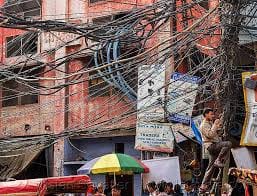
It's lost on moderns that India looks like India because of Indians; your company will begin to look dysfunctional like India in proportion as more Indians are hired. The radical atomization of capitalistic Western societies leads to individuals who are unable to process the notion that groups of people act collectively to advance an ethnic (group) interest, or that groups of people related by biology, tradition, language and history will share an affinity, an outlook that is very distinct from homegrown varieties. Americans come from broken homes and families where first cousins, aunts and uncles are not part of their life, save at funerals and yearly holiday get togethers. America has no social capital because we are not a sociable society and haven't been in decades.
Zoom out for a moment and look at India from 20,000 ft. The subcontinent has 1.4 billion people and produces so little for the human race besides more Indians. I do not believe their neighbors to the east – the Chinese – are comparable in numbers based on good evidence. Bear with me here for a small detour.
The Chinese population is much smaller than the 1.3 billion figure given out and various researchers have come up with clever ways to sus out a more realistic number, but this blog is not about that. There is a buffet of commentary on the strange emptiness of their once bustling cities over the past few years available on YouTube. It cracks me up that there is a cottage industry of research into Chinese demographics based on metrics like salt intake. It's a very clever way of measuring demographic changes along with other proxies.
During Covid, there were reports of registered cell phone numbers shrinking quite dramatically. Here we are in the Current Year and inquiring minds are finding good proxies which can reliably by-pass the defensive measures that make formal, deep studies into the Chinese census obtuse.
The Chinese produce though, just not more people. They have turned their country into the industrial park of planet earth in the span of three or four decades and will far outpace other nations in using robots as a key support for their industrial sector as their population ages and dies. Their ingenuity is now being shown in the West in video games and AI. The Chinese have an extreme advantage when it comes to transitioning their economy to a robot-driven/AI-guided future of bounty.
India? Not so much. Communism truly vitiated Chinese culture, but I suspect the wisdom, the power, the creative juices of the people will erupt in splendor with the demise of the CCP. I hope they begin to reclaim the better parts of their traditions and customs.
Indians will of course blame the British for their stunted national development. I'm not aware of any Indian studio producing a cutting edge video game rooted in story telling, vivid imagery and traditional folk lore. I am not aware of any major products produced there apart from pharmaceuticals. We use Chinese software, TikTok being the most obvious, but even Weibo has picked up use in the West. With its massive population, has India ever produced a global social media channel like Facebook or TikTok?
The much smaller nation of Japan was blown to bits and, by the end of World War II, had two cities reduced to rubble by atomic weapons. Its peak population was 127 million at the turn of the century (2000), yet it has produced many of the world's most reliable, iconic cars for the world's middle class. Japan also produces fine musical instruments, surgical tools, electronics, precision equipment, high quality eyewear domestically. It does these offshore as well, but whatever they make at home has a higher price that is justified and worth paying. India? Not so much. Oi, because the Bri'ish, mate.
(Yes, I will eventually end up buying and playing Black Myth: Wukong. I saw a clip last night and thought immediately of Arthur Waley's translation of the Chinese Buddhist folktale, Monkey. Highly recommend this work.)
I read a comment the other day about the Chinese and their dominance in dozens of fields where Westerners once held top position. The Chinese have done all this without importing Indians. Imagine that. Chinamen in China have surpassed peers in dozens of crucial technical fields without an H1-B program equivalent to staff their companies, universities and research centers. Westerners can't even conceive of Chinese building products and technologies without relying on anyone but themselves (and the Westerners they steal IP from). That sort of self-reliance and self-direction is admirable, but these are qualities alien to the Western mind now. The Chinese poisoning of many hundreds of thousands of innocent people in the West with fentanyl is not so admirable. China is ruthless, has a long game and is in it to win it.
I'm using China here to illustrate that India is a laggard and, if conceding my claim that China is smaller in population by hundreds of millions, it becomes evident that not all groups show the same spirit of innovation, ingenuity and industriousness that East Asians do. But East Asians do not dominate the IT pipeline into the American corporate sector and very few people in the West ask questions around the racial disparities seen in IT departments. Zoomers produce TikTok videos discussing the bleak prospects ahead of them for good jobs, family building and overall quality of life. They are not so hip to say (publicly at least) that their birthright was given away to less capable people whose only strength is having a backward culture which produces a servile mentality perfectly suited to corporate dominance hierarchies. India's primary export is its excess population and their character and temperament makes them the universal office worker of globo-homo. They are indentured servants by nature, lacking any tradition of excellence which elevates their industry to a global scale.
Google long ago stopped any pretense to innovation, probably around the same time the company started turning brown. According to AI, the exact makeup of Google's workforce is unknown and that's by design, in an era where diversity is praised as the fuel of American innovation. If you think America is innovative – and I don't just mean technology – you probably don't live here.
Indians show a racial cohesiveness, a commitment to advancing one another and their control over American businesses that is admirable if ultimately, destructive. It's rather like admiring the diligence of a termite colony as it invades your home and destroys its walls and floors. Americans have no natural immune system for withstanding the onslaught of organized ethnic networking, having been fed a steady stream of pablum about diversity being a strength, etc. since birth.
The Chinese laugh of course as they watch their enemy defeat itself. Sun Tzu is still a very relevant classic in modern Chinese society. The leadership has its own set of intimidating problems, but it no doubt looks at America and says, "Well, at least we are not as bad as they are." Something about never interfering with the enemy when he is in the process of destroying himself comes to mind...
Why do Indians colonize and eventually take over IT departments? One never hears of them doing the same to marketing, building services, accounting or legal. There are several reasons for their artificial inflation here.
First, IT is a hard discipline requiring a lot of mental energy and focus, both for teams and individuals. The truth is that most people who enter the field burn out quickly on it. It's rare to see a young programmer finish up doing the same type of work three or four decades later at a higher level (senior architect/CTO/principal scientist/etc.). Many people pursue programming in particular because it promises an income and job stability that is missing in the West, only to find out the work can be difficult, stressful and not conducive to work/life balance. Burn out and stress lead to an industry where job hopping is normal; technology causes stress for those who work with it up close. All of our technical conveniences aimed at easing the stress of human life end up exacerbating it, starting with the people who make it.
Put another way: I've worked with some very bright and amiable accountants and medical people. You can work in those fields your whole career.
Given the fact Americans do not reproduce, there is pressure on businesses to pay higher wages for skilled workers. IT is not an optional, nice-to-have department; it is vital to the functioning of any business. So while it became popular to talk about information technology as a "cost center," it is indispensable for a successful business of any real size. So replace "cost center" mentally with "vital core." All business relies on information and this in turn must be structured, stored, protected, shared and otherwise maintained if it is to serve as the lifeblood of a company. Think of a medium sized business with a catalog of specialty parts that it makes on spec using specialized tooling. The shipping logistics, the machine templates, the accounting, everything in the process is tied to a microprocessor and the information streams it produces and shapes.
The American programmer of the 1990s was in the driver's seat so far as salary was concerned. The advent of the Internet as a staple of normie life (instead of the specialty of universities and the armed forces) meant that information sharing was the basis for a transformation of the economic system. Programmers could name their price at the close of the last century. By 2000, I was making over $100K as a consultant with an excellent firm. That didn't last with the collapse of the DotCom bubble, but still.
I remember one story of a programmer in my city who was given a job at $100K for maintaining a few Perl CGI scripts which processed web form inputs for a small business. E-commerce was very primitive at this time and the salary was, by 1996 standards, a small fortune to pay a twentysomething fresh out of college. ChatGPT avers that the same salary would be equivalent to $190-200K in 2025. There was a gold rush stampede to the digital store and such crazy salaries made sense when weighed against the payout. Every business had the potential in those days to reach the entire world with its products. Amazon was just one of many start ups trying to capitalize on e-commerce.
Inflated labor prices could not (and did not) last, but the milder cases of wage spikes were a stark warning to corporate America that the new information frontier would not be conquered cheaply. This realization came instantaneously and during a period which saw the radical de-industrialization of American society. Tens of thousands of factories were shuttered and moved overseas beginning in the early 1990s, when AOL and CompuServ shiny CDs were slowly winding their ways into mailboxes. The new IT industry, once the haunt of basement dwellers in tall buildings, burgeoned into a whole new field for a much wider group of youngsters, many with design and liberal art degrees. In other words, non-traditional nerds (GenXers in many cases) who came at problems from different angles, some good and not so good.
The old factories of the legacy economy needed industrial engineers, machinists, electricians, architects, plumbers and so on; under NAFTA, these roles were no longer for Americans, but for people in foreign countries. The country lost a large swath of skilled and semi-skilled professions. IT roles became a stop gap, a screen to hide the level of devastation wrought by the Clintons and their neoliberal backers. If de-industrialization was going to work as an enrichment scheme for the up and coming oligarchs, it needed IT to become commoditized. In other words, something that could be packaged and moved around the globe, completely fungible and thus, under constant downward price pressure, as was done with the factory worker. Western IT labor could not have leverage over capital because of its members' wealth producing skills. A factory worker has no leverage; a very bright programmer with ideas has a lot of leverage over a business.
Capitalism found a solution to the problem of skilled IT labor and their high price tags by offshoring jobs to India; and by importing Indians into the States through a visa program whose sole purpose was to drive down the wages of everyone working in the new technical fields. Between the end of the DotCom meltdown and 2020, I and many of my peers saw our wages go flat thanks to India. While ominous reports of widening income inequality continued over this same period, no one in the mainstream linked the phenomenon of the nouveau billionaire tech bro to the gutting of the middle class and the sacking of its stable IT economy. Intelligent people of course knew the cause, but their voices are confined to the fringes of discourse.
But what exactly did Indians qua Indians bring to the game that other countries like China didn't? Two words: Grinding poverty. And some other things...
China was by 2001 a member of the WTO and was already seen by many as the new emerging industrial engine of a planetary capitalistic hyper-economy. Its people were poor still, but their prospects were breathtaking. Late 1960s China contrasted with its 2001 version showed just how capable the Chinese people are at wealth building. Capitalists were only too happy to find an intelligent people willing to work for much cheaper wages to produce goods for Westerners, especially Americans. However, there was very little interest in importing Chinese labor to do the IT work. There are a few reasons for this.
First, Chinese is a difficult language even for native speakers. I know this from watching a lot of YouTube videos in which Chinese people discuss the challenges of their own mother tongue. It is difficult for them to even get their mouths to make certain sounds that are constant in English, like th and l. I've worked with East Asians and have seen them struggle with English all the while being very bright and capable, ideal colleagues in fact. East and West have very different languages and the psychology involved in mastering either is very different. Start with phonetic alphabet vs ideographic. The scripts used by Chinese people have phonetic components, but there is still a level of abstraction that makes their language harder to master for a Westerner.
More critically, Chinese have higher IQs relative to India and could pose a serious threat to the native oligarchical class. I want to emphasize could since in the lists of corporate executives, East Asians in general don't seem to advance very far despite their IQs. Had the American capitalists imported Chinese programmers instead of Indians, that imbalance might not exist today.
Indians were colonized by the British and, over the course of many decades, the English language became part of daily life. It's not unusual to see an Indian tv or news show and hear them dropping a string of English words and phrases. To my foreign ears, it appears at times like India has blended two very distinct languages – the local dialect of whatever state and English – to a degree that gives Indians a decisive advantage in the global IT labor market.
If you are a white Anglo-Saxon capitalist looking to gut your country of its middle class, you could not do better than to go to the land of grinding poverty where petrified dominance hierarchies have had millennia to create a workforce – fluent in English of course – with a psychology of obeisance and a desperate need to please. Latin America, Africa, the Near East – none of them combines the right ingredients in such perfect, exploitable proportions. China's poverty was always temporary, even fleeting: India's is endemic to the place.
I once worked for a doctor who just loved going to India to visit his offshore team. His ego relished the adoration of dozens of Indians bowing and scraping before him. Nurses remarked that he glowed for weeks after each trip. This is a powerful drug, one that capitalists in senior positions in American society don't get much of unless they reach Elon Musk/Jeff Bezos tier. For a small or medium business, clueless executives are able to construct all sorts of possible outcomes of wealth generation through the elimination of domestic labor. Young Indians are gifted, full of vast potential, the lights of a new golden age, THE FUTURE!
When you envision the perfected City on a Hill, it will be filled with Vivek Ramaswamy's and their mommies!
The reason most goods are as expensive as they are is because of human labor. Eliminate human labor, keep the good and you end up with something that is much, much cheaper. Or, a good that is slightly cheaper but with a much higher profit margin. What are your priorities? If you are a company like Apple, it's the latter. The company is infamous for its high margins, made possible by Chinese human labor. While capitalists here are bitching about $3,500 iPhones in a tariff-clad future, LLMs are able to relay the real costs and calculate margins for the same. Let's just say Apple and China are going to eat a lot of the price increases caused by tariffs and even then, both will still do fine.
In this ZeroHedge article, "Points For Honesty: UK Tech Firm Says 'Only Immigrants From India Will Be Considered' In DevOps Want Ad," Tyler Durden highlights a recent case in which a tech firm showed an open racial bias against the native stock of a white country in favor of a specific group – Indians. Twenty years ago, Indians were quietly taking over IT departments throughout the Western world, but they were more subdued, not as prone to bragging. Within the past few years, this has gone out the window as companies like Google and Microsoft became Indian-led companies.
Vivek Ramaswamy brought more attention to himself for slamming American culture and, by extension, its users than he ever did while running as a presidential candidate. Suddenly, people wanted to know what the gifted brown billionaire did to achieve the American dream following his outburst in December, 2024. What great invention did young Vivek oversee, what luminous company did he bring into existence which has improved the lives of many while providing benefits to his adopted country of Friends-watching retards? A few clicks later, they discovered that young Vivek gamed the system the way any Indian would, harming investors and setting back drug research by years if not decades, through fraud.
"Points for Honesty" is like most articles on Indian shenanigans, more interesting for the observations of commenters who, like me, have been forced to work with the children spewed from the mouth of Brahma.
Commenter got.banned says:
Once you let one Indian in 1000 will pop like mushrooms at your firm. Blink and we are flooded with them at my place of enslavement.
Capt. Baboon observes:
This has been going on in Canada for ages. Only Indians get hired here in tech
notpcperson goes on to share three articles (here, here and here) highlighting just a few recently "discovered" instances of Indian grifting leading to direct harm of Americans and other Westerners. Imagine competing as an American against people who paid $1,300 for a fake computer science degree and have a phony network to validate the roles and responsibilities on their resume they've never held. The American is carrying tens of thousands in college debt and is starting at the bottom in a field filled with frauds. To hear it told now, heritage Americans – white, black, brown – are too stupid to do medical school, too ill-prepared, but India is fine for the training of doctors. These types of views are never challenged in the mainstream. If India is so well put-together, has such an advanced culture where hundreds of millions are studying and working hard, why aren't they like the Chinese? Why haven't the Chinese imported them en masse?
China went from being net importer of cars to the lead exporter of the same in the span of a few years. Western observers are looking closely at BYD vehicles in particular with fear and trembling since they are, from close examination, cheaper and better quality than the Western variants from legacy auto-producers like Ford and GM. BYD built a vertically integrated system for manufacture, where everything is produced locally, much like Toyota did in the early days leading to its global success. The U.S. relies on a sprawling network of parts suppliers and DCs to do the same, building lower quality vehicles at much, much higher costs.
My Ford truck left me stranded on the road one day because the engine overheated. A "cheap" gasket had failed in the cooling system. Its was $110 for another flimsy replacement. A truck with low mileage and well-maintained, it did not last 10 years. It's 76K miles saw it falling apart and Ford dealers unwilling, unable to work on them because of a labor shortage.
A few years ago, Ford mentioned that the F-150 had a lot of extra parts that could be reduced by adopting a better design.
Much is made now of the new yellow menace – the Chinese and their theft of IP, currency manipulation and so on. Not an eye bats at the destruction caused by incompetent Indians being allowed into positions where they have no business being, here in America and elsewhere.
theandymancan shares his experience working internationally on tech projects with Indians:
Just 5 years ago I was in charge for a high-tech project in Muscat/Oman. The contractor was Bahwan engineering. And guess [what]... the whole project team and the rest of the company - all Indians. They openly bragged in front of me that "we Indians control the company and the business."
Things change and in our times, it's usually for the worse. Change is another word for impermanence and civilizations don't really die, they just off themselves. Much like alcoholism and drug use are a kind of prolonged process of suicide for an individual, nations and civilizations undergo the same, where they lose the will to live. The individual mind oscillates between eternalism and nihilsm. Most of us tend to be a little bi-polar, capable of moments of happiness that are washed away by a quiet hope for a quick, painless death when things go against us. Civilizations do the same. The whirling mind of the individual and of the collective seem to suffer from the same affliction. We should not be surprised that the collective psyche magnifies the human mind, its passions, fickleness and inconstancy.
This particular issue of American surrender to global capitalism has impacted me for decades, making every job a little worse, a little less enjoyable, more cause for economic anxiety than it's worth. One of the reasons I turned to the Buddha was to find out his remedy for the stresses and inconstancy of life. His answers have been sound and reliable, but the human form is weak and still seeks refuge in ephemeral things. Jobs, careers and professional relationships are especially unstable in a time of decline. Mentally, spiritually practice becomes even more essential.
When the capitalist came for the factory jobs, I was not a factory worker and said nothing. When the capitalist came for the skilled tradesman, I was not a skilled tradesman so said nothing. When the capitalist came for the IT professional, I was an IT professional, but there was no left to stand up to them.
I want to share some advice here for young men who are considering what to do. Becoming a skilled tradesman is an honorable path and equally important, a rewarding one personally and financially. Over the years, I've talked to skilled contractors who make a good living and many of them have an option not available to other fields – the ability to build a small successful business that is prosperous. The IT fields (programming and networking) have already become closed systems as the oligarchy anticipates the elimination of most white collar jobs in the next few years to AI. The days of a few people building a life-long viable small business from a new app are long gone. College students in computer science programs are being set up for debt and financial failure. The jobs are gone and they are not coming back.
I do not think these expectations are exaggerated at all and even if they are, the fact is AI will greatly reduce the need for humans in accounting, legal and any other area where information – the use of words, reasoning and grammars – can be handed off to an agent. AI in its present form is the breakdown and analysis of words and symbols and its reconstitution into forms that are clear of debris. Human knowledge is cleared up of ambiguity in technical and mundane matters, such that information becomes even more useful, more targeted to problems. The potential for gross abuse by the zampolitik who act as AI's handlers goes without saying.
Skilled tradesmen will see their incomes decline as the rest of the middle class is hollowed out. Poor, unemployed people will not be in a position to buy new homes or remodel their existing one, so electricians and other tradesman will have an important consumer base fade away. That said, there is a silver lining: A skilled laborer will always be more valuable than an obese, out-of-shape office worker who has spent years lost in a bureaucracy. Most corporate workers deal in verbiage and have little in the way of practical problem solving skills that hold value outside of a narrow specialty, say programming or digital marketing.
Trump has made much about re-industrializing the heartland, restoring local supply chains. Let's be clear: This campaign is not about new jobs. The American oligarchy understands that there are staggering levels of risk to their own positions in the event China – which is a basket case economically – goes sideways and starts a hot war. I tend to think the claims of Chinese militarism to be quite ridiculous, but the Western leadership does not share this view. Apple is bringing money on-shore and is investing in local factories which will be autonomous. Its foray into India for iPhone construction resulted in a high level of human feces in the final product and so the effort was shut down. Apple has milked China and that cow is empty, angry and erratic.
What is reliable from an oligarch's perspective is a local factory staffed mostly by robots on property heavily subsidized by tax rebates, grants and incentives. Think of the new Trump factories as the industrial equivalent of professional, taxpayer subsidized sports stadiums. America is run on the notion of public risk, private gain. In other words, put other people's money at risk, but be in a position to reap all of the profits if there is success. Appeal to the age-old principle of trickle down economics to make it seem like the normie is getting something out of the ballooning wealth inequality which, as of now, has buried at least two generations, the Millennials and the Zoomers. Remember that the current president amassed $26 billion hocking a shitcoin just days before his second inauguration. That is America.
A versatile, skilled tradesman will still be in a position to work on the re-industrialization projects. Buildings will have to be built, plumbing, electrical and other infrastructure laid, robots or no. I doubt building architects will be of much need in a few years as AI will be able to spit out a highly optimized architectural plan in seconds for any fabrication process. The AI will weed out inefficiencies that might never occur to a human planner. Indians will not be brought into replace unskilled tradesmen in all likelihood. American capitalists would be much more likely to turn to Mexico and Latin America for that.
Predicting when the end of all white collar work will end is difficult, but "soon" works. In the time left, young men would be wise to become skilled, save every penny and plan on life as a homesteader in some place far from the city. The U.S. is a dying dragon and will thrash around as it sinks into the gloom of death.